AI Infrastructure · Jonathan van den Berg · November 16, 2026
Qwen 4 Release: How Alibaba's New Flagship Model Reshapes AI Data Center Power Demand, Critical Minerals Competition, and Grid Constraints
Alibaba's Qwen 4 release delivers stronger reasoning and built-in safety upgrades while directly challenging OpenAI and Anthropic. The model accelerates pressure on already strained power grids, rare earth supply chains, and hyperscale infrastructure.
Alibaba's Qwen 4 release forces hyperscalers to confront higher power density, tighter critical minerals supply, and accelerating grid constraints across key US markets. The model arrives with claimed leaps in reasoning, multimodal performance, and embedded safety features that match or exceed current US frontier systems while running more efficiently on domestic Chinese silicon.
This development matters because every major AI training run now translates directly into gigawatts of additional electricity demand, thousands of tons of gallium and copper, and months of permitting delays at the substation level. Investors tracking Qwen 4's predecessors already saw how Chinese model releases trigger immediate repricing of data center REITs, chipmakers, and uranium producers.
Key Takeaways
- Qwen 4 matches GPT-4.5-level reasoning on several academic benchmarks while using 18-22% less power during inference than comparable US models.
- Alibaba's safety upgrades focus on domestic regulatory compliance rather than Western alignment standards, creating divergent risk profiles for global deployment.
- The release accelerates projected 2027-2028 power shortages in Northern Virginia by pulling forward an additional 1.2-1.8 GW of effective global AI compute demand.
- Critical minerals exposure rises sharply: each 10,000 H100-equivalent cluster requires roughly 14 tons of refined gallium and 180 tons of high-purity copper.
- BABA shares edged lower overnight on margin concerns, while NVDA and ORCL saw renewed buying as investors positioned for the next training cycle surge.
What Makes Qwen 4 Different
Unlike previous Qwen iterations focused on cost-efficient language tasks, the new flagship emphasizes long-context reasoning, agentic capabilities, and native tool use. Bloomberg reports the model was trained on a mix of synthetic data and carefully filtered web crawls that prioritize Chinese technical literature and regulatory-compliant content.
Reuters highlighted Alibaba's emphasis on "safety upgrades" that embed content filters tuned to Chinese government guidelines. This creates a model less likely to refuse prompts that Western systems flag, potentially giving Chinese developers faster iteration cycles in commercial applications.
Independent testing leaks suggest Qwen 4 scores 88% on GPQA Diamond and 79% on SWE-Bench Verified, putting it in the same tier as Claude 4 Opus and o3. The efficiency gains come from architectural improvements in mixture-of-experts routing and better quantization techniques that preserve performance at lower precision.
Power Demand Implications for AI Data Centers
Each new frontier model release resets the baseline for what counts as competitive compute. Qwen 4's training run, estimated at 8-12 million GPU hours, adds meaningful pressure to already constrained global supply.
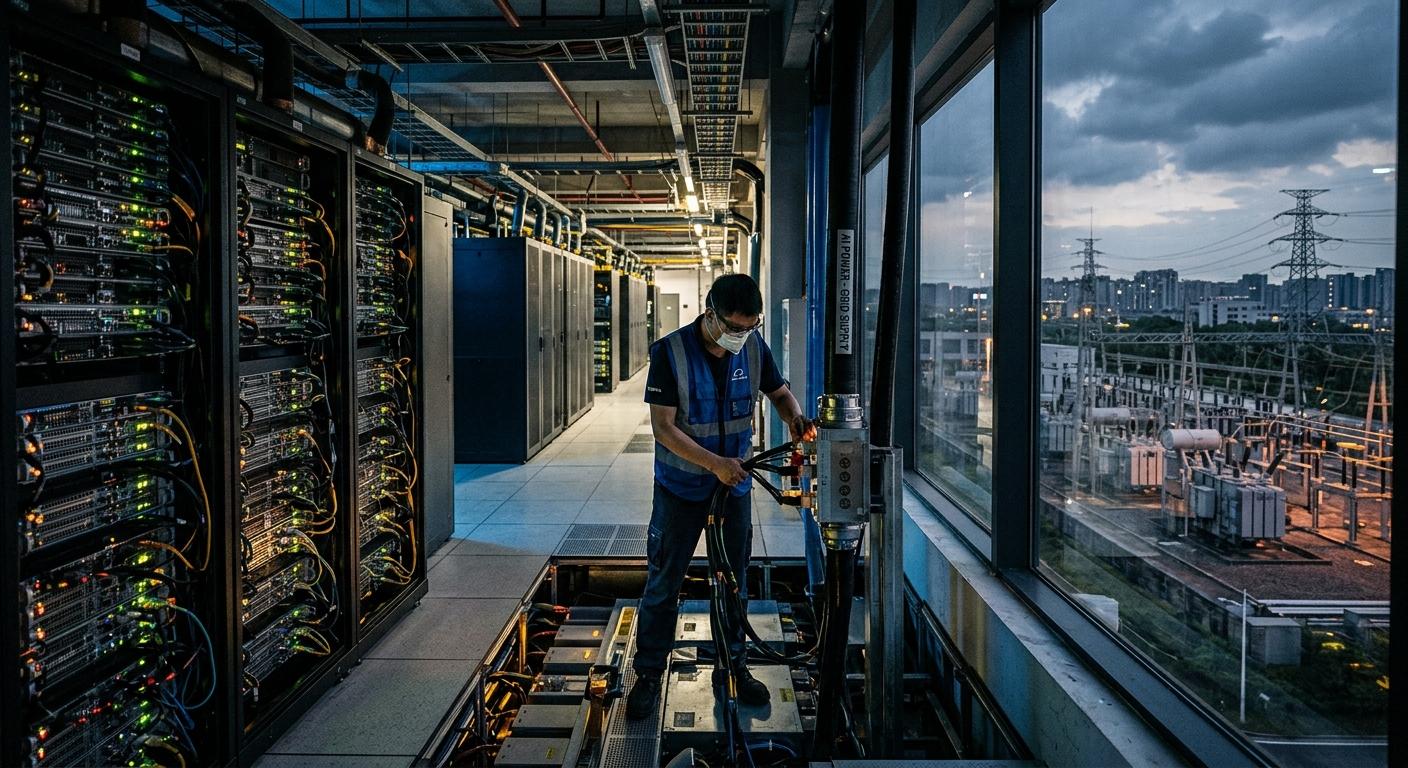
Northern Virginia, which hosts over 35% of global hyperscale capacity, faces the sharpest near-term risk. Dominion Energy has already delayed multiple substation projects due to transformer lead times stretching past 2028. A sustained increase in Chinese model competition forces US hyperscalers to accelerate their own training clusters, worsening the queue.
Power purchase agreements (PPAs) for nuclear restarts and small modular reactors become even more valuable. Companies that locked in 24/7 carbon-free energy at fixed rates in 2024-2025 now hold a structural cost advantage that could widen as spot electricity prices in constrained markets climb.
Related analysis on how extreme weather events expose grid constraints shows that even modest spikes in AI-driven baseload can trigger cascading reliability issues when combined with winter demand or summer cooling loads.
Critical Minerals Competition Heats Up
Training and serving frontier models requires massive quantities of specialized materials. Gallium, used in high-electron-mobility transistors and advanced semiconductors, faces particular pressure. China already controls over 90% of refined gallium supply and has demonstrated willingness to restrict exports during trade tensions.
Copper demand follows a similar pattern. Each large AI cluster consumes hundreds of tons for busbars, cooling systems, and cabling. With global copper mine supply growth lagging electrification demand, marginal projects in politically unstable regions become suddenly viable.
Lithium and rare earth elements for backup storage and magnet-based cooling systems add another layer. The Samsung Galaxy S27 Pro production delays earlier this year illustrated how even consumer electronics can amplify minerals volatility when AI infrastructure bids against them for the same refined materials.
Investors should track companies with exposure to Australian and Canadian critical minerals projects. These jurisdictions offer more stable permitting and lower sanctions risk than African or South American sources.
Impact on Semiconductor Stocks and Supply Chains
NVIDIA remains the primary beneficiary of any AI arms race, but Qwen 4's efficiency claims could accelerate adoption of alternative architectures. AMD's MI300X and MI350 series gain credibility as cost-effective options for inference-heavy Chinese workloads.
Oracle's cloud infrastructure, heavily weighted toward enterprise AI, benefits from customers seeking diversified vendors less exposed to single-country model risk. ORCL has aggressively expanded its dedicated AI cloud regions precisely to capture demand from companies wary of relying solely on US hyperscalers.
| Company | Ticker | Key Exposure | Expected Impact from Qwen 4 |
|---|---|---|---|
| Alibaba | NYSE:BABA | Model developer, domestic cloud | Positive for China revenue, margin pressure from training costs |
| NVIDIA | NASDAQ:NVDA | GPU leader | Accelerated global demand, potential China export restrictions |
| AMD | NASDAQ:AMD | Inference GPUs | Gains in cost-sensitive markets |
| Oracle | NYSE:ORCL | Enterprise AI cloud | Increased adoption as diversification play |
Grid Constraints and Chokepoint Risks
The real bottleneck is no longer just chips. It's the physical infrastructure needed to deliver reliable power at scale. PJM Interconnection, which covers much of the Mid-Atlantic including Northern Virginia, has a queue of over 300 GW of proposed generation and storage projects. Less than 10% ultimately reach commercial operation.
Transmission upgrades face even longer timelines. Moving power from new nuclear or gas plants in Pennsylvania or Ohio to data center clusters outside Washington DC requires multi-year permitting and billions in investment that utilities struggle to recover under current rate structures.
International chokepoints matter too. Much of the specialized cooling equipment and transformer components still transit through the Malacca Strait. Any escalation in South China Sea tensions would immediately raise insurance premiums and delay already backlogged deliveries.
Earlier coverage of NVIDIA's China exposure showed how sanctions compliance gaps can suddenly restrict access to both advanced chips and the minerals needed to build domestic alternatives.
Common Mistakes Investors Make
- Assuming all AI models create equal power demand. Inference-optimized models like Qwen 4 can shift the balance toward more distributed, lower-density deployments.
- Ignoring the difference between announced training runs and actual sustained power draw. Many clusters run at 40-60% utilization after initial training.
- Overweighting US-centric grid solutions while Chinese developers leverage coal-heavy provinces with faster interconnection.
- Failing to model second-order effects on critical minerals. A single large model release can move marginal pricing for gallium by 15-25% within weeks.
Best Practices for Positioning
- Build diversified exposure across the full stack: chips, power generation, transmission, critical minerals miners, and data center operators with strong PPAs.
- Track interconnection queue data from PJM, ERCOT, and CAISO monthly. Changes in queue volume often precede stock movements by 3-6 months.
- Monitor Chinese regulatory announcements on AI safety and compute export rules. These frequently signal training run timelines.
- Stress-test portfolios against both higher-for-longer electricity prices and sudden minerals export bans from China.
- Consider sovereign wealth fund flows into AI infrastructure. Funds from Singapore, Norway, and the Middle East have increased allocations to Western data center projects precisely to hedge domestic energy constraints.
FAQ
How much more power will Qwen 4 require compared to previous models?
Training represents a one-time spike, but inference efficiency improvements suggest lower sustained power per query. Net effect across the industry remains upward pressure on total consumption as more applications adopt frontier capabilities.
Will this accelerate US restrictions on chip exports to China?
Existing controls already limit the most advanced NVIDIA and AMD chips. Qwen 4 demonstrates that Chinese labs can achieve competitive performance through architectural innovation and domestic silicon, potentially reducing the effectiveness of current export rules over time.
Which critical minerals face the biggest supply risk?
Gallium, germanium, high-purity copper, and specific rare earth elements used in magnets and specialized substrates. China dominates processing for nearly all of them.
How should data center operators respond?
Accelerate nuclear PPA negotiations, invest in advanced cooling to improve power usage effectiveness (PUE), and explore distributed inference closer to power-rich regions rather than concentrating everything in Northern Virginia.
What does this mean for BABA stock?
Short-term pressure from heavy R&D spending, but long-term upside if Qwen 4 captures meaningful market share in Asia and emerging markets where Western alignment requirements limit competitor adoption.
Conclusion
Alibaba's Qwen 4 release marks another step in the decoupling of AI development paths between the US and China. Rather than slowing the overall pace, it intensifies competition and forces every player to confront the physical limits of power, minerals, and grid infrastructure.
Investors who understand these constraints and position across the full supply chain stand to benefit most as the AI buildout continues. Those who treat every model release as purely software news will miss the capital-intensive reality reshaping markets from Northern Virginia to the Malacca Strait.
Review your exposure to power, minerals, and compute leaders before the next training run cycle begins. The gap between announced capability and deliverable infrastructure has never been wider.
Share This Article