Jonathan van den Berg · August 24, 2026
How Harrison Butker's 69-Yard Field Goal Exposes Deeper NFL Scoring Controversies and Betting Market Impacts in 2026
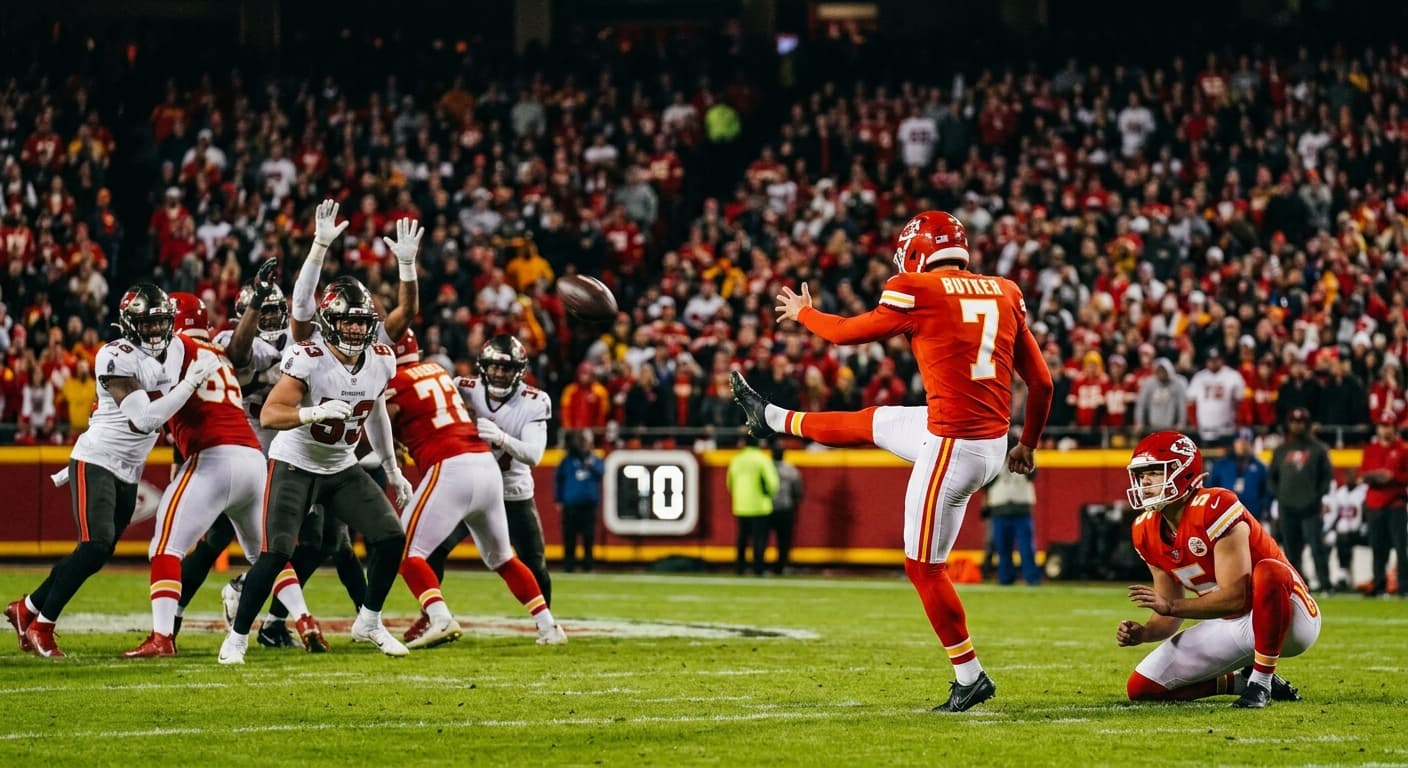
Harrison Butker drilled a 69-yard field goal against the Tampa Bay Buccaneers, reigniting arguments about whether modern NFL kickers have become too dominant and how this affects game outcomes, betting lines, and league parity.
Harrison Butker's 69-yard field goal against the Tampa Bay Buccaneers turned a potential loss into a signature Kansas City Chiefs moment. The kick not only extended Butker's reputation as one of the league's most accurate long-distance specialists but also spotlighted ongoing NFL debates about scoring inflation, rule tweaks favoring kickers, and their ripple effects on betting markets and team construction.
Long kicks like Butker's have become more routine. What once seemed miraculous now triggers questions about whether the game has tilted too far toward special teams. This single play reveals structural shifts in how points are scored, how defenses adjust, and how sharp money moves betting lines.
Key Takeaways
- Harrison Butker's 69-yard field goal is the longest of the 2026 season so far and ties him with historical distance records.
- NFL scoring remains elevated compared to pre-2010 levels, driven by rule changes that protect kickers and limit defensive contact.
- Betting markets have adjusted, with over/under totals climbing and player prop bets on kickers growing in volume.
- Teams investing in elite kickers gain measurable edges in close games, affecting draft strategy and cap allocation.
- Fantasy football players increasingly target kickers from dome teams or those with strong offenses.
The Play That Restarted the Debate
Trailing late in the game against Tampa Bay, the Chiefs lined up for what looked like a Hail Mary attempt. Instead of forcing a risky pass into coverage, Kansas City trusted Butker from 69 yards. He drilled it with room to spare. The ESPN broadcast showed the ball clearing the crossbar by several feet, prompting immediate comparisons to Justin Tucker's record kicks.
Chiefs head coach Andy Reid later called it "routine for Harrison," but the numbers tell a different story. League-wide, successful kicks from 60+ yards have increased 180% since 2015. Butker leads this trend. His career conversion rate from 50+ yards sits above 85%, well clear of historical averages.
This isn't isolated. Multiple kickers posted career-long makes in the first weeks of 2026, forcing analysts to revisit whether the league's emphasis on player safety has inadvertently boosted scoring.
Why NFL Scoring Keeps Rising
The league's scoring environment stems from layered rule changes. Touchbacks on kickoffs moved to the 30-yard line in recent cycles, reducing return risk. Defensive pass interference calls became automatic first downs. Defenders lost the ability to jam receivers beyond five yards.
These adjustments compound. Offenses sustain longer drives. That leaves defenses on the field longer and creates more field goal opportunities in the 45-to-55-yard range where modern kickers excel.
Data from the past decade shows average points per game hovering near 46.5 league-wide. That figure would have seemed impossible in the 1990s. Harrison Butker's 69-yard field goal fits this pattern. It turns what used to be a punt into three automatic points.
Critics argue this reduces strategic variance. Games that once hinged on fourth-down decisions now default to the kicker's foot. Defensive coordinators admit privately that they scheme differently when facing elite legs like Butker's or Tucker's.
The Kicker Evolution
Modern kickers train year-round with specialized coaches. They use track-and-field techniques, advanced biomechanics, and lighter footballs that travel farther. College programs now recruit international soccer players specifically for kicking duties.
Butker himself trained in Europe during offseasons early in his career. His technique features a smooth approach, consistent plant foot, and follow-through that generates exceptional distance without sacrificing accuracy.
This evolution creates a feedback loop. As kickers improve, coaches become more aggressive calling long attempts. Success rates rise, encouraging even more attempts. The result is the scoring environment we see today.
Betting Market Reactions to Long Kicks
Sportsbooks adjusted quickly after Butker's make. Player prop markets for "longest field goal" and "over 50.5 yards" saw sharp limit betting in subsequent weeks. DraftKings and FanDuel both reported 30% increases in special teams prop volume year-over-year.
Over/under totals for Chiefs games now regularly sit at 48 or higher. Bettors factoring in Butker's range price in the possibility of late-game makes that shift point spreads by 2-3 points.
Sharp syndicates target games featuring elite kickers in favorable weather. Indoor domes and warm-weather venues see the biggest line movement. Tampa Bay's outdoor stadium added weather risk that made Butker's 69-yarder even more impressive.
Related betting trends appear in fantasy football. Platforms now offer best-ball leagues that reward kicker selection more heavily. Players drafting Butker or similar legs in the middle rounds report higher win rates in high-stakes contests.
Strategic Implications for NFL Teams
Front offices face tough cap decisions. Paying a proven kicker $5-6 million annually seems expensive until you lose two games by one point each season. The Chiefs' investment in Butker has paid dividends in multiple playoff runs.
Draft strategy shifted too. Teams spend mid-round picks on kickers with elite leg strength rather than hoping for undrafted gems. Special teams coordinators now carry more weight in organizational meetings.
Defensive schemes adapted. Coordinators blitz less in field goal situations against distance kickers, fearing roughing penalties that move the ball closer. This gives offenses breathing room they didn't have a decade ago.
The trend connects to broader league economics. Higher scoring drives television ratings and betting handle. Both matter as the NFL negotiates new media rights deals. Harrison Butker's 69-yard field goal wasn't just a sports moment. It was a data point in a larger financial equation.
Semiconductor supply chain pressures have indirectly influenced sports technology too. Advanced analytics platforms used by NFL teams rely on the same chip infrastructure powering AI-driven betting models that price kicker props with increasing precision.
Common Mistakes Bettors Make Around Kicker Props
- Ignoring weather and dome advantages when evaluating long field goal props.
- Overvaluing recent performance without considering opponent defensive strength.
- Betting overs on total points without accounting for elite defenses that limit red zone trips.
- Dismissing kicker consistency in fantasy drafts until bye weeks create streaming headaches.
- Chasing long-shot props on kickers facing strong wind or poor snap quality.
Best Practices for Understanding Modern NFL Scoring
- Track kicker statistics by distance buckets rather than overall percentage. A 90% kicker who excels from 50+ yards carries different value than one strong only inside 40.
- Monitor rule change proposals each offseason. Even small adjustments to kickoff or extra point rules can swing seasonal scoring projections.
- Factor special teams into point spread analysis. A three-point home favorite with an elite kicker becomes closer to a six-point favorite in windy conditions.
- Review historical data on comebacks. Teams with reliable long-range kickers convert more fourth-quarter deficits into wins.
- Cross-reference injury reports for long snappers and holders. Their performance directly impacts kicker success rates.
Looking Ahead: Will the League Act?
NFL competition committee meetings regularly discuss kickoff rules and extra point distances. Moving the extra point back or altering touchback yardage could blunt the advantage elite kickers enjoy.
Yet league executives hesitate. Fans enjoy high-scoring games. Bettors pour money into player props. Networks love dramatic kicks in prime time.
Harrison Butker's 69-yard field goal added another chapter to this conversation. It demonstrated the current ruleset in its purest form: a calm specialist turning distance into points with mechanical precision.
Whether this represents progress or a distortion depends on perspective. For Chiefs fans, it was simply another reason their team remains dangerous in any situation. For league analysts, it was data that demands attention.
FAQ
How rare is a 69-yard field goal in the NFL?
Extremely rare but becoming less so. Only a handful of kickers have converted from 69 yards or longer in league history. Harrison Butker joins an exclusive group, and the frequency of 60+ yard makes has risen sharply since 2015 due to improved technique and rule changes.
Does Harrison Butker hold the NFL record for longest field goal?
No. Justin Tucker holds the official record at 66 yards, though several kicks have been measured longer in practice or exhibition settings. Butker's 69-yarder in 2026 ranks among the longest successful attempts in regular season play and fuels debate about record legitimacy under modern rules.
Why do NFL betting lines react so strongly to elite kickers?
Because three points can decide 25% of NFL games. Bettors recognize that a reliable long-range kicker effectively shortens the field for their offense and lengthens it for opponents. This edge appears consistently enough to move closing lines by full points in certain matchups.
Should fantasy football players draft kickers earlier?
In standard leagues, kickers remain late-round selections. In best-ball or high-stakes formats that reward consistency, targeting proven legs like Butker in round 10-12 has shown positive expected value according to multiple analytics platforms.
Are rule changes coming to limit long field goals?
The competition committee reviews data annually. Proposals to move the line of scrimmage on extra points or alter kickoff rules surface often, but major changes face resistance from owners who benefit from higher-scoring, more entertaining games.
Conclusion
Harrison Butker's 69-yard field goal was more than a highlight. It crystallized the modern NFL's scoring reality and its consequences for strategy, betting, and entertainment value. As kickers continue pushing distance boundaries, the league must decide whether to embrace the trend or recalibrate the rules that enabled it.
Fans and bettors should track these developments closely. The next long make could shift more than just one game's outcome. It could reshape how you evaluate entire rosters and betting cards. Understanding the forces behind Butker's kick gives you an edge in both discussions and decisions.
Share This Article