The Inner Path · April 14, 2026
Energy Politics in the Midwest: How Alliant Energy Navigates the Geopolitical Storm of 2026
As global energy markets remain volatile amid shifting U.S.-China relations, European sanctions fallout, and domestic political pressures, Alliant Energy finds itself at the center of America’s Midwest power struggle — balancing reliability, renewable mandates, and rising geopolitical risks in electricity generation.
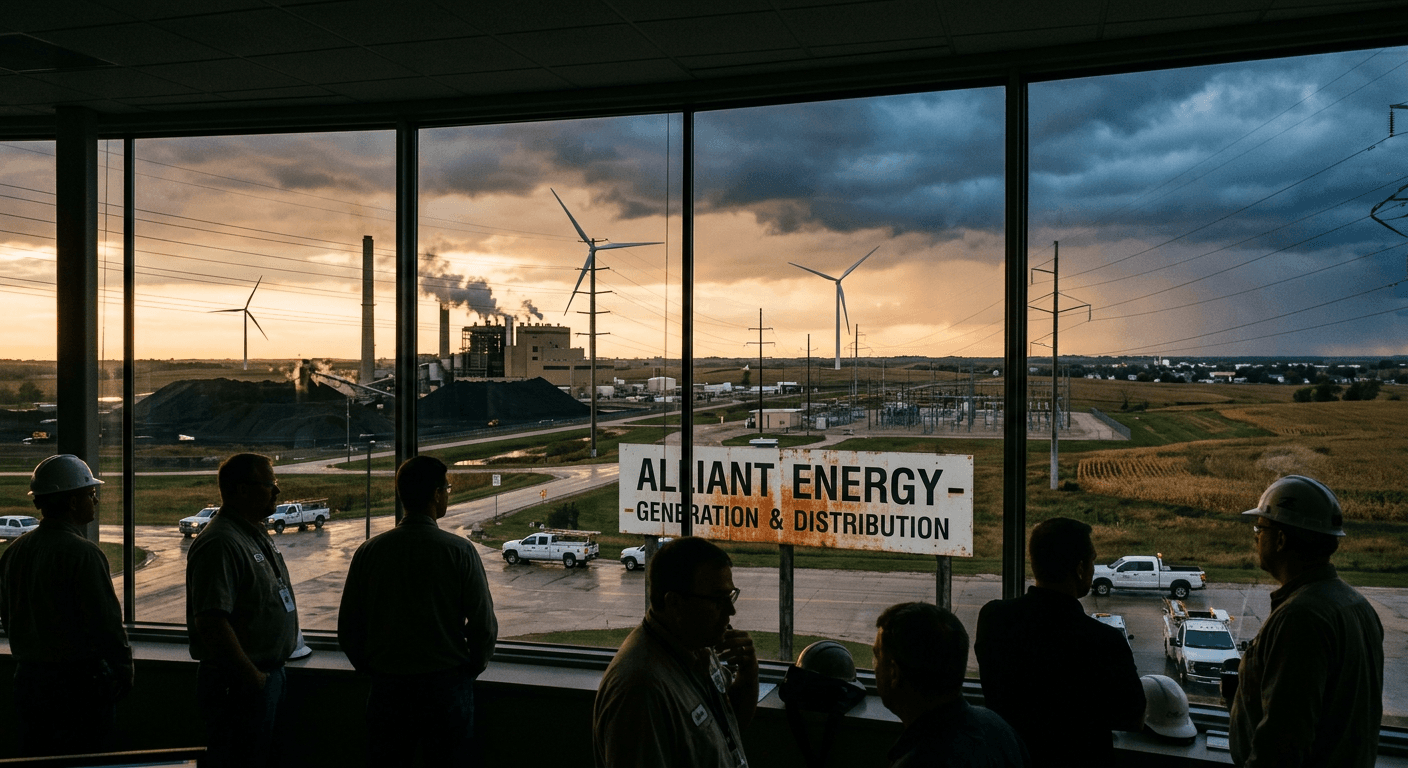
On April 14, 2026, searches for “Alliant Energy” surged across the United States as severe spring weather swept through the Upper Midwest. While many users sought outage updates amid tornado watches in Wisconsin, the company’s sudden prominence reflects deeper structural forces reshaping the American energy landscape. Alliant Energy Corporation, the Iowa- and Wisconsin-based utility holding company, operates at the intersection of domestic infrastructure resilience, national decarbonization policy, and global commodity geopolitics.
In an era defined by great-power competition, supply-chain weaponization, and energy security concerns, even seemingly provincial utilities have become strategic actors. Alliant’s decisions regarding coal plant retirements, natural gas infrastructure, wind and solar expansion, and nuclear considerations carry implications far beyond its 1.6 million electric and 500,000 natural gas customers in Iowa, Wisconsin, and Illinois.
The Global Energy Context of 2026
The world energy order continues to fragment. Following Russia’s prolonged conflict with Ukraine and subsequent Western sanctions, global natural gas markets have undergone permanent restructuring. Europe’s accelerated shift away from Russian pipeline gas has kept liquefied natural gas (LNG) prices structurally higher, influencing U.S. domestic pricing and export policy. Meanwhile, China’s aggressive expansion of domestic coal, nuclear, and renewable capacity has created parallel supply chains for critical minerals, solar panels, and battery technology — often at geopolitical cost to Western manufacturers.
The United States finds itself caught between energy dominance ambitions and domestic political polarization. The Trump administration’s second-term energy policy, emphasizing “energy dominance 2.0,” has prioritized expedited permitting for fossil fuel infrastructure while maintaining selective support for certain renewable tax credits. This contradictory stance has created regulatory uncertainty for utilities like Alliant Energy, which must satisfy state renewable portfolio standards in Wisconsin and Iowa while facing shareholder pressure and federal tax policy volatility.
According to the U.S. Energy Information Administration’s latest Short-Term Energy Outlook (April 2026), Henry Hub natural gas prices are averaging $3.85 per million BTU — up 22% from 2025 averages due to increased LNG exports to Europe and Asia. Midwest utilities are feeling this pressure acutely as they balance winter heating demands with summer air-conditioning peaks that are intensifying due to climate-driven weather volatility.
Alliant Energy’s Strategic Position
Alliant Energy operates approximately 15,000 megawatts of generating capacity across its service territory. As of Q1 2026, the company’s generation mix consists of roughly 38% coal, 32% natural gas, 24% wind, 4% solar, and smaller contributions from nuclear purchases and biomass. This mix places Alliant in the middle of the national transition curve — more progressive than many southeastern utilities but lagging behind California and New York clean energy leaders.
The company’s most significant strategic document remains its “Forward Looking Energy Plan” updated in late 2025. The plan calls for the retirement of the remaining coal units at the Lansing and Ottumwa facilities by 2028-2030, to be replaced primarily by a combination of new combined-cycle natural gas plants, additional wind capacity in Iowa, and substantial battery storage deployments. However, analysts have noted that recent global events have forced Alliant to reconsider the pace of this transition.
The Critical Minerals Challenge
One of the most significant geopolitical headwinds facing Alliant’s renewable ambitions is the concentration of critical minerals processing in China. Lithium, cobalt, nickel, and rare earth elements required for utility-scale battery storage remain heavily dependent on Chinese refining capacity. The Biden-era Inflation Reduction Act’s domestic content bonuses have been partially retained but face legal challenges and administrative reinterpretation in 2026.
Alliant’s 2025 announcement of a 100 MW battery storage project in Wisconsin was delayed by six months due to supply chain constraints on battery cells. Industry sources indicate that Chinese export restrictions on graphite and refined lithium, imposed in retaliation for U.S. semiconductor and AI restrictions, have increased battery costs by an estimated 18-24% since 2024. For a utility operating in relatively low-rate jurisdictions, these cost increases create substantial political risk when requesting rate recovery from state utility commissions.
Wisconsin and Iowa: Battlegrounds of Energy Federalism
The political geography of Alliant’s service territory adds complexity. Wisconsin’s Public Service Commission, with its 2026 composition reflecting Republican legislative control but a Democratic governor, has adopted a cautious approach to aggressive decarbonization. Iowa, by contrast, has maintained strong bipartisan support for wind energy due to rural economic benefits, with over 60% of the state’s electricity now coming from wind during peak production hours.
This divergence creates portfolio challenges for Alliant. While Iowa regulators have approved multiple wind repowering projects, Wisconsin’s focus on reliability — especially after the devastating derecho event of 2020 and subsequent winter storms — has led to greater emphasis on dispatchable generation. The company’s recent filing for a new 650 MW natural gas combined-cycle plant near Beloit, Wisconsin has drawn both environmental opposition and support from manufacturing interests concerned about electricity costs and reliability.
Tornado Risk and Infrastructure Resilience
Today’s trending “tornado watch Wisconsin” searches highlight another dimension of the geopolitical energy equation: climate adaptation. The National Weather Service and Channel 3000 weather coverage reflect increasing frequency of extreme weather events across the Midwest. These events carry direct economic costs for utilities — Alliant reported $87 million in storm-related capital expenditures in 2025 alone.
From a broader geopolitical perspective, climate resilience has become a domain of strategic competition. Chinese state-backed manufacturers have captured significant market share in high-efficiency transformers, advanced conductors, and grid modernization technologies. U.S. efforts to reshore transformer production through the Department of Energy’s Grid Resilience and Innovation Partnerships program have shown limited success, with lead times for large power transformers still exceeding 30 months as of early 2026.
Alliant Energy’s Financial Markets Context
As a publicly traded company (NYSE: LNT), Alliant Energy’s performance reflects broader market sentiment regarding regulated utilities in an inflationary, high-interest-rate environment. With the Federal Reserve maintaining a cautious stance on rate cuts amid persistent service sector inflation, utility stocks have faced pressure due to higher financing costs for capital-intensive infrastructure projects.
Alliant’s stock has underperformed the broader utility sector in 2026, trading at approximately 16.8 times forward earnings compared to the sector average of 18.2. Credit rating agencies Moody’s and S&P have maintained stable outlooks but have flagged increasing regulatory and political risk as a potential negative factor. The company’s ability to secure reasonable returns on equity from state commissions — currently authorized at 9.8% in Iowa and 10.0% in Wisconsin — will prove critical to funding its approximately $4.2 billion five-year capital expenditure plan.
Natural gas price volatility, driven by global LNG arbitrage opportunities, represents both risk and opportunity. Alliant’s hedging program has successfully mitigated some price spikes, but prolonged European demand for U.S. LNG continues to link Midwest electricity rates to international geopolitical developments in ways that would have seemed impossible two decades ago.
The Nuclear Option and Small Modular Reactors
One of the more intriguing developments in Alliant’s long-term planning involves renewed interest in nuclear energy. With global interest in small modular reactors (SMRs) accelerating — particularly following successful deployments in China and Russia — several Midwestern utilities have begun preliminary feasibility studies.
Alliant has joined the Nuclear Energy Institute’s SMR working group and is conducting site evaluations at former coal plant locations for potential NuScale or GE-Hitachi BWRX-300 deployments in the 2030s. This represents a significant geopolitical pivot. While solar and wind technology supply chains remain dominated by China, nuclear technology leadership still rests primarily with the United States, France, South Korea, and Russia. A successful American SMR industry could represent one of the few clean energy domains where the West maintains a competitive edge.
However, regulatory uncertainty at the Nuclear Regulatory Commission, combined with significant upfront capital requirements, makes this a high-stakes gamble for a mid-sized utility. Alliant’s leadership has emphasized that any nuclear commitment would require substantial federal financial support through either the Department of Energy’s loan guarantee program or production tax credits.
Conclusion: Energy as Strategic Imperative
The convergence of today’s weather-driven searches for Alliant Energy with broader geopolitical and economic realities reveals an uncomfortable truth: there is no longer any such thing as a purely local utility. In 2026, every decision regarding power plant retirements, fuel sources, transmission investments, and rate structures exists within a global context of great power competition, critical minerals warfare, climate policy fragmentation, and technological rivalry.
Alliant Energy’s challenge — and that of dozens of similar regional utilities — is to maintain affordable, reliable electricity for American households and industries while navigating an international environment characterized by strategic distrust. The company’s success or failure will not be measured merely in customer satisfaction scores or regulatory approval rates, but in its contribution to American energy resilience in an increasingly contested world.
As tornado watches sweep across Wisconsin and Iowa this spring, the deeper storm facing Alliant Energy and the American energy system is the one reshaping global power relationships. The utility’s ability to balance these competing pressures will help determine not just regional economic competitiveness, but America’s broader strategic position in the emerging multipolar energy order.
The coming decade will test whether regulated utilities, often viewed as sleepy infrastructure businesses, can rise to meet the geopolitical moment. For Alliant Energy and its customers, the forecast calls for continued turbulence — both meteorological and geopolitical. Examples like Hawaii's EPA-rejected oil plant conversion and the high cost of green energy mandates illustrate how aggressive decarbonization timelines can collide with reliability and economic realities nationwide.
Share This Article