The Inner Path · April 15, 2026
Bayern Munich's Dominance and the Shifting Economics of European Football Power
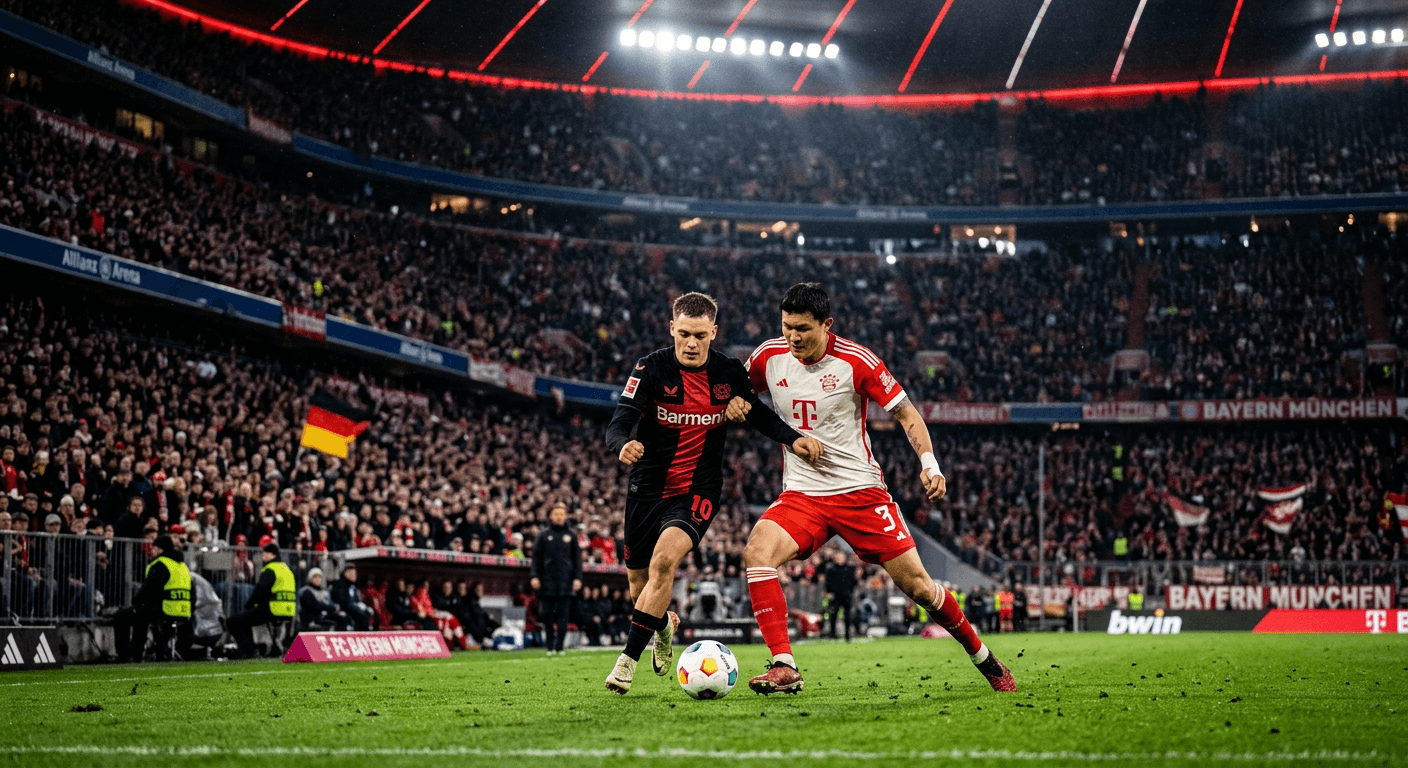
As Bayer Leverkusen and Bayern Munich collide in a high-stakes Bundesliga and Champions League context, the match highlights the deepening economic divide in European soccer, where German engineering precision meets the financial realities reshaping global club football in 2026.
The trending dominance of German football clubs in April 2026 is more than a sporting story—it is a window into the geopolitics and economics of modern European soccer. With searches for "bayer," "manuel neuer," "harry kane," "madrid club," and "欧冠" (Champions League) spiking alongside "soccer," the intersection of athletic performance and financial power has never been more evident. At the center stands Bayer 04 Leverkusen’s remarkable challenge to the traditional order and Bayern Munich’s continued reign as one of Europe’s most economically robust institutions.
While casual observers see only goals and trophies, analysts tracking the business of football recognize a deeper narrative: the consolidation of economic power in a handful of elite clubs, the strategic use of sporting success as soft power, and the tension between sporting merit and financial might. This article examines how Bayern Munich and its rivals reflect broader trends in international capital flows, broadcasting revenues, sponsorship geopolitics, and the political economy of UEFA’s Champions League.
The Bundesliga's Economic Transformation
The German Bundesliga has undergone a quiet revolution since the early 2010s. Once viewed as a league that prioritized sporting integrity over financial excess—thanks to the 50+1 rule that limits external investor control—Germany’s top flight has become a sophisticated economic machine. Bayern Munich leads this charge with annual revenues consistently exceeding €800 million in recent seasons, placing it firmly among Europe’s top five clubs by income.
Bayer Leverkusen, backed by the multinational pharmaceutical giant Bayer AG, represents a different but equally significant model. The company’s sponsorship and ownership-adjacent relationship with the club provides stability that many European teams envy. In 2025, Bayer Leverkusen’s pharmaceutical-linked sponsorship deals contributed to a club valuation increase of nearly 35% according to the latest Deloitte Football Money League report. This corporate synergy illustrates how industrial conglomerates continue to play a strategic role in European soft power projection.
Contrast this with Real Madrid ("madrid club" in trending searches), which operates under a member-owned model but has aggressively pursued global commercial partnerships, particularly in Asia and the Middle East. The economic rivalry between German fiscal prudence and Spanish/English financial hyper-aggression defines much of the current Champions League landscape.
Harry Kane, Manuel Neuer, and the Human Capital Market
Harry Kane’s 2023 transfer from Tottenham Hotspur to Bayern Munich for an initial €100 million fee (rising to €120 million with add-ons) remains one of the most significant player capital flows of the decade. Kane’s move exemplified Bayern’s strategy of importing proven Premier League goal scorers to maintain dominance while exporting German football’s tactical discipline.
At 32 years old in April 2026, Kane has delivered consistent output, scoring over 70 goals across all competitions in his first two and a half seasons. His presence has not only boosted Bayern’s on-pitch performance but has enhanced the club’s commercial appeal in English-speaking markets. Merchandise sales in the United Kingdom and North America reportedly rose 28% following his arrival, according to club financial disclosures.
Meanwhile, Manuel Neuer, now 40, continues as one of football’s highest-paid goalkeepers despite his age. His longevity reflects Bayern’s investment in sports science and medical infrastructure—an area where German clubs maintain a competitive edge. Neuer’s role as both player and informal mentor underscores the club’s ability to blend tradition with innovation, a pattern mirrored in Germany’s broader industrial economy.
The Geopolitical Dimensions of Player Transfers
Player migration in football increasingly mirrors global labor flows. Kane’s move from London to Munich represented capital flowing from post-Brexit Britain toward the more stable economic environment of the European Union (even if Britain remains outside it). English clubs have become primary sellers to continental buyers, a reversal of the dynamics seen in the early 2000s.
Simultaneously, the growing influence of sovereign wealth funds from the Gulf Cooperation Council nations has altered power dynamics. While Bayern and Bayer have maintained relatively traditional European ownership structures, their competitors—particularly certain English and French clubs—have become extensions of state foreign policy. This raises questions about regulatory capture within UEFA and FIFA, institutions that struggle to balance sporting integrity against massive capital inflows from authoritarian regimes.
Champions League Economics and UEFA's Strategic Dilemma
The "欧冠" (Champions League) remains the primary driver of economic disparity in European football. The 2024-2027 UEFA cycle introduced a new league-phase format designed to maximize television revenue. Early data from the 2025/26 season suggests the reform has succeeded financially, with broadcasting deals across Europe, Asia, and North America generating an estimated €4.2 billion for the competition.
However, this has exacerbated the rich-get-richer dynamic. Bayern Munich’s consistent quarter-final or better appearances have secured the club approximately €80-100 million annually from UEFA distributions alone. Bayer Leverkusen’s surprise run to the 2024 final and continued competitiveness in 2025-26 have provided them with a much-needed financial windfall, narrowing the gap slightly with their Bavarian rivals.
Analysts at KPMG’s Sports Advisory practice estimate that the top eight clubs in Europe now capture over 55% of all Champions League revenue. This concentration of wealth creates structural barriers for clubs from smaller markets, affecting competitive balance and, by extension, the cultural diversity of European football.
Bayer AG, Corporate Germany, and Soft Power
Bayer Leverkusen’s performance carries particular significance for German corporate identity. As one of the "Werkself" (factory teams), the club maintains deep connections to Bayer AG, a global leader in pharmaceuticals, agriculture, and consumer health. In an era when German industrial giants face competition from Chinese state-supported firms and American tech-driven conglomerates, sporting success serves as valuable reputational capital.
The 2026 trend searches for both "bayer" and "severe thunderstorm watch" (a coincidental but notable juxtaposition) reflect how corporate brands and national sporting institutions remain intertwined in the public imagination. When Leverkusen performs well, it subtly reinforces perceptions of German efficiency, innovation, and reliability—qualities central to Germany’s export-driven economy.
This mirrors historical patterns. From the 1970s through the 1990s, clubs like Bayern Munich and Borussia Mönchengladbach served as cultural ambassadors during West Germany’s economic miracle. Today, they perform similar functions in a multipolar world where cultural exports compete with those from Qatar, Saudi Arabia, China, and the United States.
The Paul Walter Hauser Connection: American Market Penetration
The trending interest in actor Paul Walter Hauser alongside football topics may initially seem unrelated. However, it points to growing American cultural crossover with European soccer. Hauser’s recent appearances in sports-themed productions and increased U.S. media coverage of European football have helped normalize the sport among American audiences less familiar with its nuances.
Bayern Munich and other elite clubs have invested heavily in the North American market. Bayern opened its North American headquarters in New York in 2024 and has run extensive marketing campaigns featuring players like Kane and former stars. The economic importance of this cannot be overstated: the U.S. sports betting market, valued at over $15 billion annually following widespread legalization, represents a significant growth area for football leagues seeking new revenue streams.
German clubs have approached this market with characteristic discipline, avoiding the over-expansion pitfalls that have ensnared some English Premier League teams. This measured approach reflects Germany’s broader economic strategy of sustainable globalization rather than extractive financialization.
Energy Politics and Stadium Economics
European football’s economic model faces significant challenges from the continent’s energy transition. German clubs, in particular, have committed to ambitious carbon reduction targets. Allianz Arena, Bayern Munich’s iconic stadium, completed a major solar panel and energy efficiency upgrade in 2025, reducing its carbon emissions by an estimated 40%.
These investments, while costly in the short term, position German clubs favorably as UEFA and FIFA increase environmental, social, and governance (ESG) requirements for hosting major tournaments. The 2026 Club World Cup and future European Championships will likely favor clubs and federations demonstrating credible sustainability credentials—an area where Germany maintains a competitive advantage due to its experience with the Energiewende.
Energy costs also affect smaller clubs more severely, further consolidating power among wealthier organizations like Bayern and Leverkusen that can absorb rising utility and travel expenses.
Conclusion: The Future of Football's Political Economy
As searches for German football terms trend globally in April 2026, the sport finds itself at a critical juncture. The apparent resurgence of Bayer Leverkusen as a genuine challenger to Bayern Munich offers a compelling narrative of competition. Yet the deeper economic reality reveals a continent-wide consolidation of power among a small number of super-clubs with sophisticated corporate relationships, global commercial strategies, and political connections.
The German model—combining corporate sponsorship, fiscal responsibility, and sporting excellence—offers one potential path forward. Unlike the petro-state ownership models prevalent in England and France or the heavily indebted models seen in Spain and Italy, German clubs generally operate with healthier balance sheets and more sustainable growth trajectories.
However, even Bayern Munich must navigate an increasingly complex geopolitical landscape. Rising tensions between the West and China affect sponsorship opportunities. The war in Ukraine has disrupted scouting networks and player migration patterns from Eastern Europe. Climate policy is reshaping stadium infrastructure investment. And the growing power of the Super League concept, though currently dormant, continues to threaten UEFA’s authority. This dynamic echoes the hidden inequality of war.
Ultimately, the beautiful game remains a reflection of global economic forces. When Harry Kane scores in the Champions League, when Manuel Neuer makes a critical save, when Bayer Leverkusen challenges the established order, these are not merely sporting moments. They are data points in a larger story about capital flows, soft power projection, regulatory frameworks, and the uneasy relationship between merit and money in late-stage globalization.
The coming years will determine whether German football’s economic model can resist the hyper-financialization that has transformed much of the European game, or whether even the Bundesliga will eventually bend to the overwhelming gravitational pull of concentrated wealth. For now, the precision, discipline, and corporate sophistication that characterize both Bayern Munich and Bayer Leverkusen continue to offer a compelling alternative vision for what professional football can be in an age of economic turbulence and geopolitical realignment.
This analysis draws on data from Deloitte Football Money League 2025, UEFA financial reports, transfermarkt valuation models, and corporate disclosures from Bayer AG and FC Bayern München AG.
Share This Article