Jonathan van den Berg · April 21, 2026
Ferguson Unrest Echoes in Global Energy Politics
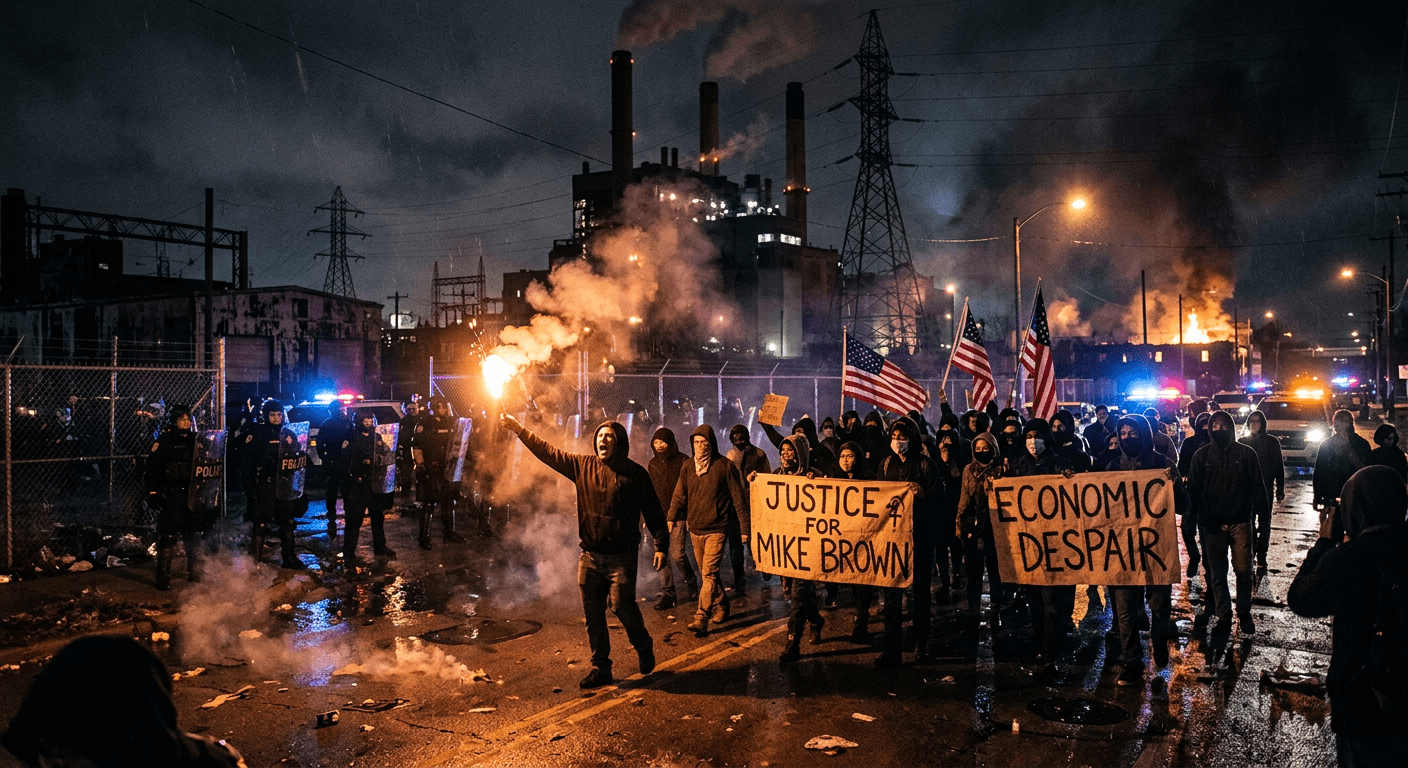
What do protests in a declining American industrial city reveal about the intersection of domestic instability and international energy security? The Ferguson crisis, rooted in economic despair and social fracture, mirrors broader geopolitical vulnerabilities in energy-dependent nations facing internal unrest.
Ferguson reveals deep fractures. Once a symbol of American suburban stability, the Missouri city became a flashpoint for debates over inequality, policing, and economic decline. Yet beyond its immediate social context lies a subtler geopolitical reality: how domestic instability in key nations can ripple through global energy markets, supply chains, and strategic calculations.
The 2014 events in Ferguson, triggered by the police shooting of Michael Brown, exposed long-simmering tensions in post-industrial American communities. More than a decade later, the structural economic problems that fueled that unrest continue to influence U.S. domestic politics and, by extension, America's posture on the world stage. This has direct implications for energy politics, sanctions regimes, and great-power competition.
The Economic Roots of Ferguson
Ferguson's transformation from a majority-white middle-class suburb in the 1970s to a predominantly Black community with high poverty rates by the 2010s mirrors broader patterns of deindustrialization across the American Midwest. Manufacturing jobs that once sustained families disappeared as production moved overseas, particularly to China. Between 2000 and 2014, St. Louis County lost thousands of stable blue-collar positions while municipal budgets increasingly relied on aggressive policing and fines to generate revenue.
According to economic analyses from that period, Ferguson's poverty rate exceeded 20 percent by 2010, with unemployment rates significantly higher among Black residents. The city's reliance on traffic fines and court fees created a predatory revenue model that disproportionately affected lower-income citizens. This economic pressure cooker set the stage for explosive social unrest.
These local dynamics reflect larger macroeconomic shifts. The expansion of global trade, China's entry into the World Trade Organization in 2001, and the offshoring of American manufacturing hollowed out industrial communities across the United States. What happened in Ferguson was not isolated but symptomatic of a wider erosion of the American industrial base that once underpinned both domestic stability and geopolitical strength.
Energy Politics and Domestic Stability
Energy security has long been intertwined with social cohesion. Nations experiencing severe internal divisions often struggle to maintain consistent foreign policies on energy issues. The United States, as the world's largest energy producer and consumer, is no exception.
The shale revolution that began in the mid-2000s dramatically altered America's energy position. U.S. crude oil production rose from roughly 5 million barrels per day in 2008 to over 13 million by 2023, transforming the country from a net importer to a net exporter. This energy independence strengthened America's hand in imposing sanctions on adversaries like Iran, Russia, and Venezuela.
Yet domestic instability threatens to undermine these advantages. Communities like Ferguson, scarred by economic decline, often become politically volatile. Their grievances fuel populist movements that challenge establishment foreign policy, including energy-related sanctions and alliances. The political polarization that intensified after Ferguson contributed to inconsistent U.S. approaches to energy exports, pipeline projects, and climate policy across different administrations.
The Russia-Ukraine Conflict Connection
Russia's 2022 invasion of Ukraine and the subsequent energy crisis in Europe highlighted how domestic American politics affect global energy geopolitics. While the Biden administration rallied European allies to impose sweeping sanctions on Russian energy exports, political divisions at home limited America's ability to rapidly increase LNG exports to replace Russian pipeline gas.
Communities affected by deindustrialization, similar to those in Ferguson, have mixed views on expanded fossil fuel production. Some see LNG terminals and drilling as economic lifelines, while others, influenced by environmental concerns or distrust of corporate power, oppose them. This fragmentation has slowed America's ability to fully capitalize on its energy abundance in service of geopolitical objectives.
European nations, facing energy shortages, turned desperately to U.S. supplies. American LNG exports to Europe surged from 22 billion cubic meters in 2021 to over 56 billion cubic meters in 2023. However, the political difficulty of building new export terminals and expanding domestic production revealed the constraints that internal divisions place on American energy statecraft.
China's Strategic Calculations
Beijing has closely monitored America's internal challenges. Chinese strategists view domestic unrest and political polarization in the United States as strategic opportunities. The Ferguson unrest and its aftermath contributed to a narrative in Chinese state media about American decline and hypocrisy on human rights.
This perception influences China's approach to energy geopolitics. Beijing has accelerated its Belt and Road Initiative energy projects across Asia, Africa, and Latin America, seeking to reduce vulnerability to potential Western sanctions. China's stockpiling of oil and its diversification of natural gas supplies through pipelines from Russia and Central Asia reflect lessons drawn partly from observing America's internal vulnerabilities.
Moreover, China's dominance in rare earth minerals and solar panel manufacturing creates new dependencies. The same economic globalization that contributed to Ferguson's decline has also made the United States reliant on Chinese supply chains for critical energy transition materials. This dependency constrains American options in any potential conflict over Taiwan or in the South China Sea.
Sanctions Effectiveness in a Polarized Era
The effectiveness of Western sanctions has come under increasing scrutiny. While coordinated sanctions on Russian energy exports initially appeared successful, the emergence of alternative markets in China, India, and Turkey demonstrated the limits of sanctions when the imposing powers face domestic political constraints.
U.S. secondary sanctions on entities dealing with Russian oil have been applied inconsistently. Political calculations around gasoline prices and inflation, which disproportionately affect working-class communities already experiencing economic stress, have tempered enforcement. The ghost fleet of tankers moving discounted Russian crude to Asia reveals how domestic political realities can blunt the sharp edge of economic statecraft.
Data from energy tracking firms shows that Russian oil export revenues, while initially reduced, recovered substantially through increased sales to non-Western markets. In 2023, Russia's energy export earnings remained above $300 billion despite extensive sanctions, partly because American and European political systems struggled to maintain unified resolve amid domestic divisions.
The Role of Central Banking and Energy Inflation
The Federal Reserve's monetary policy decisions are inevitably colored by domestic social and economic conditions. High energy prices following the Ukraine invasion exacerbated inflation that hit lower-income communities particularly hard. This economic pressure influenced the Fed's rate hike trajectory and complicated international coordination with other central banks.
Energy inflation in 2022 reached levels not seen since the 1970s oil crises. In the United States, average gasoline prices exceeded $5 per gallon in some regions, contributing to political backlash that affected the Biden administration's ability to maintain strong sanctions policies. Similar dynamics played out in Europe, where governments faced yellow vest-style protests over energy costs.
Central bankers increasingly acknowledge that geopolitical energy shocks interact dangerously with domestic inequality. The European Central Bank and the Federal Reserve have both referenced "fragmentation risks" in their communications, a term that encompasses both geopolitical tensions and internal social divisions.
Lessons for Future Energy Statecraft
The Ferguson unrest offers several enduring lessons for understanding the relationship between domestic stability and geopolitical effectiveness in energy matters:
- Social cohesion enables consistent policy. Nations experiencing severe internal divisions struggle to maintain long-term strategic approaches to energy security and sanctions.
- Economic despair creates political volatility. Communities affected by globalization and technological change become breeding grounds for populist movements that challenge elite consensus on foreign policy.
- Energy abundance is not enough. Even with significant energy resources, political fragmentation can prevent nations from fully leveraging those advantages in international competition.
- Perceptions matter. Adversaries like Russia and China actively exploit and amplify narratives of American decline stemming from events like Ferguson to weaken Western alliances.
These dynamics suggest that rebuilding domestic economic vitality in communities like Ferguson is not merely a social justice issue but a national security imperative. Investments in domestic manufacturing, particularly in energy-related industries, could simultaneously address inequality and strengthen geopolitical position.
The New Energy Geopolitics
The transition to renewable energy introduces additional complexities. Critical minerals required for batteries, wind turbines, and solar panels are concentrated in countries with varying degrees of political stability and alignment with Western interests. China's control over processing capacity for lithium, cobalt, and rare earth elements creates new chokepoints that echo traditional oil geopolitics.
American attempts to reshore critical mineral processing and battery manufacturing face the same political hurdles visible in debates over fossil fuel infrastructure. Local opposition, environmental concerns, and distrust stemming from decades of economic dislocation complicate efforts to reduce dependency on China.
The Inflation Reduction Act of 2022 represented a significant attempt to address both climate goals and domestic economic revival through green energy investments. However, its implementation has been slowed by permitting delays, legal challenges, and political opposition that partly trace back to the same polarization visible in Ferguson over a decade earlier.
Implications for Emerging Markets
Developing nations watching America's internal challenges have drawn their own conclusions. Many have refused to join Western sanctions against Russia, instead maintaining energy ties with Moscow while seeking investment from multiple powers. This hedging strategy reflects a world where American moral authority and political cohesion are questioned.
Countries across Africa, Latin America, and Southeast Asia increasingly demand concrete economic benefits rather than ideological alignment. The competition between Chinese infrastructure investment and Western green technology initiatives plays out against this backdrop of diminished confidence in American stability.
Brazil, India, South Africa, and other nations have strengthened ties with both Russia and China through expanded BRICS mechanisms, partly calculating that America's internal divisions limit its ability to impose costs for such realignment.
Conclusion
Ferguson stands as more than a symbol of American racial tensions. It represents the deep economic and social fissures that complicate the United States' ability to project power in an increasingly competitive geopolitical environment. In an era where energy security, critical minerals, and economic statecraft define great-power competition, domestic cohesion becomes a strategic asset.
The path forward requires recognizing that addressing the legitimate grievances of communities like Ferguson is essential to rebuilding the social contract that underpins effective foreign policy. Economic policies that revive industrial communities, reduce inequality, and restore broad-based prosperity would strengthen America's hand in energy geopolitics far more effectively than rhetorical commitments to democracy promotion or human rights.
As global energy politics grow more complex with the addition of new technologies, supply chains, and rival powers, the United States must heal its domestic divisions to maintain strategic coherence. The alternative is a future where internal weakness invites external exploitation, with energy markets serving as both the arena and the prize in great-power competition.
The lessons of Ferguson thus extend far beyond Missouri. They touch upon the fundamental requirements for maintaining influence in a world where economic strength, social cohesion, and geopolitical strategy have become inextricably linked. Addressing the root causes of such unrest is not charity but a strategic necessity in the pursuit of energy security and national power in the twenty-first century.
Share This Article