Jonathan van den Berg · April 17, 2026
China’s Economic Slowdown and the New Era of Geopolitical Competition in 2026
As China’s post-pandemic recovery falters amid collapsing property values, local government debt crises, and shrinking export markets, Beijing is doubling down on state control and technological self-reliance — moves that are accelerating decoupling from the West and reshaping global supply chains, energy politics, and alliances from Europe to the Global South.
As of April 17, 2026, China remains the world’s second-largest economy and the central node in global manufacturing and critical minerals supply chains. Yet the country is grappling with its most complex set of economic challenges since the reform era began in 1978. Youth unemployment hovers near 18%, property sector losses have exceeded $5 trillion since 2021, and local government financing vehicles carry hidden debts estimated by some analysts at over 120% of GDP. These domestic pressures are not occurring in isolation; they are driving a more assertive, state-directed geopolitical strategy that is forcing governments from Washington to Brussels to reassess their economic dependencies.
The trending Google search term “china news” reflects global anxiety about where the world’s factory is headed. Far from being a purely domestic story, China’s economic trajectory now sits at the intersection of geopolitics, energy security, technology competition, and the future of globalization itself.
The Structural Economic Crisis
China’s headline GDP growth for 2025 came in at 4.2%, according to official figures — respectable by Western standards but far below the 6%+ rates Beijing once considered its minimum acceptable threshold. Independent analysts from Rhodium Group and the Conference Board suggest real growth may have been closer to 2.8% when adjusting for deflationary pressures in the property and manufacturing sectors.
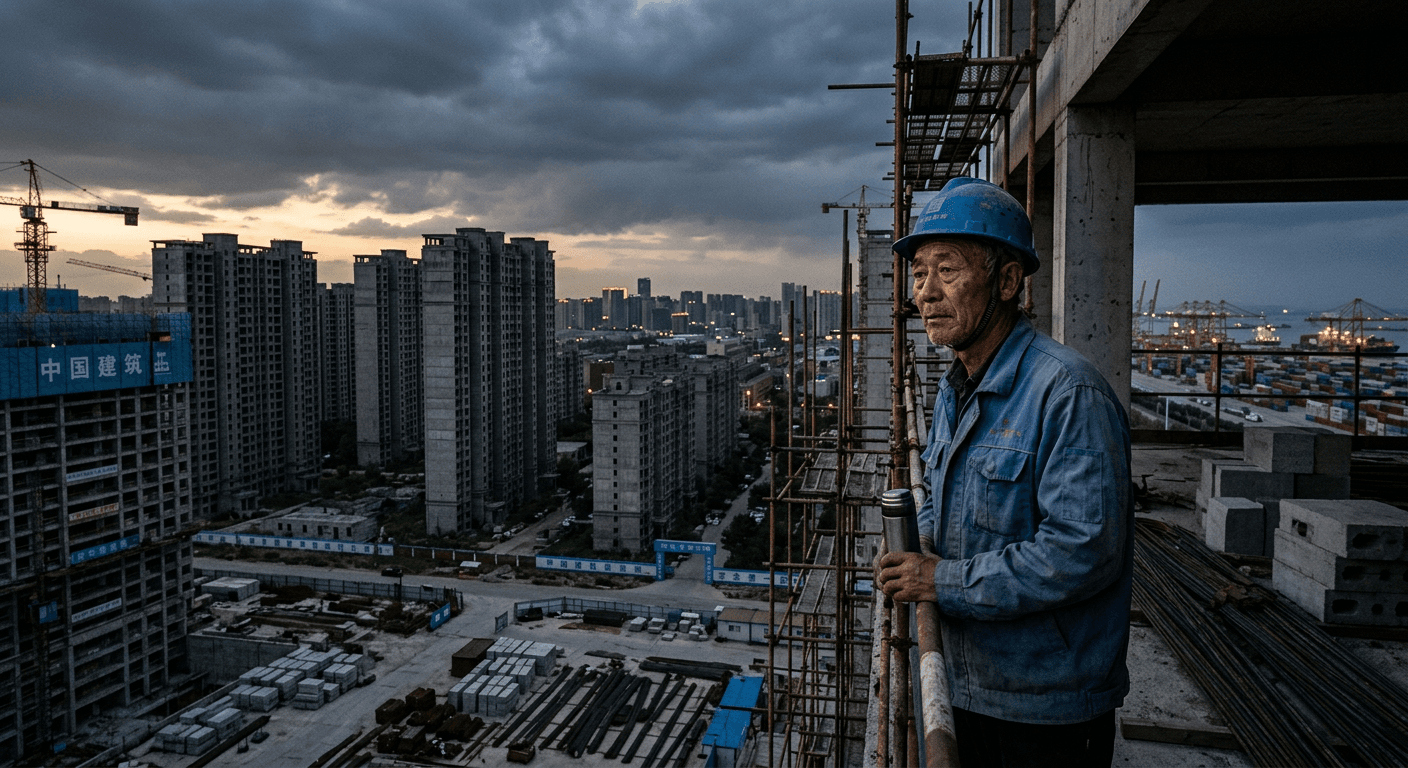
The property crisis remains the largest single drag. Evergrande’s collapse was only the beginning. By early 2026, more than 25 major developers have defaulted or restructured offshore debt. Residential prices in Tier 1 and Tier 2 cities have fallen 15-22% from their 2021 peaks. Construction activity, which once accounted for nearly 30% of GDP when including related industries, has contracted sharply. Local governments, which relied on land sales for roughly 40% of revenue in many provinces, are now facing acute fiscal shortfalls.
Simultaneously, China’s demographic crisis is accelerating. The working-age population has been shrinking since 2014. The National Bureau of Statistics reported a net population decline of 2.1 million in 2025 alone. Pension system liabilities are projected to reach 10% of GDP annually by 2035 without major reforms.
Beijing’s Strategic Response: “New Productive Forces” and State Control
In response to these headwinds, President Xi Jinping has doubled down on the strategy of technological self-reliance first formalized in the 14th Five-Year Plan (2021-2025) and reinforced at the Third Plenum in July 2024. The phrase “new productive forces” — emphasizing AI, quantum computing, electric vehicles, semiconductors, and green technology — now dominates official rhetoric.
State-directed investment has reached unprecedented levels. In 2025, central government guidance funds and provincial industrial policy vehicles deployed an estimated $380 billion into strategic sectors. This includes massive subsidies for EV production (China now controls 68% of global battery manufacturing capacity) and a renewed push in semiconductors despite US export controls on advanced lithography equipment.
However, this state-heavy approach has created clear inefficiencies. Many analysts point to overcapacity in solar, EVs, and lithium batteries. Chinese EV makers are selling vehicles in Europe and Latin America at prices 25-40% below European and American competitors, prompting the European Union to impose tariffs reaching 45% on certain models in late 2025. The resulting trade tensions have damaged relations with key partners.
Geopolitical Ramifications: The Great Decoupling Accelerates
China’s economic difficulties have paradoxically made Beijing more, not less, geopolitically assertive. Facing slower growth at home, the Chinese Communist Party views Western “de-risking” policies as an existential threat. This has produced a security-first economic policy.
The Belt and Road Initiative (BRI) has been quietly reoriented. New lending has slowed dramatically since 2022, but Beijing has shifted toward smaller, higher-quality “small and beautiful” projects and increased focus on digital silk road and critical minerals partnerships. Chinese firms now control or have significant stakes in lithium mines across Argentina, Chile, Australia, and Africa. In 2025, China signed new long-term cobalt and copper offtake agreements with the Democratic Republic of Congo that effectively lock in supply for Chinese battery makers through 2035.
Energy politics have also shifted. Despite record renewable installations, China remains the world’s largest importer of oil and gas. Beijing has diversified away from Middle Eastern suppliers toward Russia, with pipeline imports from the Power of Siberia 2 project expected to reach 38 billion cubic meters annually by 2027. This energy alignment with Moscow has deepened the Sino-Russian “no-limits” partnership even as Western sanctions on Russia continue.
US-China Technology and Financial Decoupling
The technology war has entered a new, more structural phase. The United States maintains entity list restrictions on dozens of Chinese firms, while the Netherlands and Japan have joined export controls on advanced semiconductor manufacturing equipment. China’s response has been to pour resources into its domestic semiconductor industry, achieving 18nm process technology at SMIC in late 2025 — still two generations behind TSMC’s 3nm leadership but sufficient for many military and industrial applications.
Financial decoupling is also advancing. Cross-border capital flows have become more volatile. Foreign institutional investors reduced their holdings of Chinese bonds and equities by approximately $85 billion in 2025. In response, Beijing has eased some capital controls for select foreign investors while tightening scrutiny on outbound investment by Chinese firms in non-strategic sectors.
The internationalization of the renminbi has slowed but not stopped. Roughly 28% of China’s cross-border trade was settled in RMB in 2025, up from 4% a decade earlier, though the currency remains far from challenging the dollar’s dominance in global reserves (currently ~2.4% according to IMF COFER data).
Impact on Global South and Commodity Markets
China’s economic slowdown has produced mixed effects across the developing world. Lower Chinese demand contributed to falling iron ore, copper, and coal prices in 2024-2025, hurting exporters such as Australia, Brazil, and Indonesia. Yet Beijing’s continued strategic purchases of critical minerals have provided a floor for lithium and rare earth prices.
African and Latin American nations have become more sophisticated in negotiations with Chinese entities. Zambia and Angola successfully renegotiated debt terms with Beijing in 2025, while Brazil has pursued a hedging strategy — maintaining strong agricultural exports to China while deepening technology partnerships with the United States and Europe.
The EU’s Global Gateway initiative and the US-led Partnership for Global Infrastructure and Investment (PGII) have gained modest traction as alternatives to BRI, though funding gaps remain enormous. China still outspends these programs by a factor of roughly four in most developing regions.
The Taiwan Question and Military-Economic Nexus
Economic pressure has not reduced Beijing’s determination regarding what it calls “reunification” with Taiwan. Military exercises around the island have increased in frequency and complexity. The People’s Liberation Army conducted its largest-ever simulated blockade of Taiwan in October 2025.
Economically, China has sought to increase leverage by deepening trade dependencies while simultaneously preparing for potential Western sanctions. Taiwan Semiconductor Manufacturing Company (TSMC) remains the world’s most advanced chipmaker; its potential disruption in any cross-strait conflict would shave an estimated 8-12% off global GDP according to Bloomberg Economics modeling. Both Washington and Beijing understand this reality, which explains the intense focus on semiconductor resilience and “China+1” supply chain strategies by Apple, Nvidia, and other major firms.
Europe’s Strategic Dilemma
European leaders face their own version of this challenge. Germany’s economy contracted in 2025 partly due to reduced exports to China and higher energy costs following the loss of cheap Russian gas. The European Commission’s 2026 China strategy document describes Beijing as a “systemic rival” in technology and an “economic competitor” in third markets. Yet individual member states remain divided — Hungary and Serbia continue to welcome Chinese investment while France and the Netherlands push for tougher screening of inbound Chinese capital.
The recent EU tariffs on Chinese EVs and solar panels have triggered retaliation against European brandy, pork, and luxury goods. This tit-for-tat dynamic risks further fragmenting the global trading system.
Conclusion: A Fractured Global Order
China’s economic slowdown is not merely a cyclical downturn but a structural transition with profound geopolitical consequences. Beijing’s leadership appears to have concluded that slower growth, greater state control, technological decoupling, and closer alignment with authoritarian partners represent an acceptable price for preserving the Chinese Communist Party’s monopoly on power and maintaining strategic autonomy.
For the United States, Europe, and their partners, the challenge is to balance continued economic engagement in areas where cooperation remains possible (climate, public health, certain supply chains) while accelerating resilience in critical technologies, defense industrial bases, and strategic minerals.
The era of “Chimerica” — the symbiotic economic relationship that defined global growth from 2001 to 2018 — is over. What replaces it is not yet fully formed. The data emerging in 2026 suggests a world of friend-shoring, selective decoupling, heightened industrial policy, and persistent strategic competition. How effectively Western economies and their allies manage this transition while preserving open societies and market-driven innovation will largely determine whether the 21st century remains one of broadly shared prosperity or descends into sustained geopolitical conflict and economic fragmentation.
The trending searches for “china news” in April 2026 are not idle curiosity. They reflect the uncomfortable realization that China’s internal economic challenges have become one of the primary drivers of global geopolitical risk.
Share This Article