The Inner Path · April 16, 2026
Brunei’s Strategic Balancing Act: Energy Politics, Geoeconomics, and ASEAN’s Frontline in Great Power Competition
As one of the world’s wealthiest per-capita nations and a major LNG exporter, Brunei finds itself at the intersection of South China Sea tensions, shifting Asian energy markets, and intensifying U.S.-China rivalry. Its quiet diplomacy and hydrocarbon-dependent economy reveal the complex trade-offs facing small states in an era of geopolitical fragmentation.
In the shadow of larger Southeast Asian neighbors, Brunei Darussalam often escapes international headlines. Yet this tiny sultanate on the island of Borneo, with a population of just over 450,000, remains one of Asia’s most significant energy players and a quiet actor in the geopolitics of the South China Sea. On April 16, 2026, with global energy markets still adjusting to post-pandemic demand patterns, ongoing tensions in Ukraine, and accelerating great-power competition in the Indo-Pacific, Brunei’s strategic position warrants closer examination.
Brunei’s economy is overwhelmingly dependent on oil and natural gas, which account for approximately 90% of government revenue and more than 60% of GDP. Its proven reserves of roughly 1.1 billion barrels of oil and 9.1 trillion cubic feet of natural gas place it among the region’s important suppliers. The country’s sovereign wealth fund, managed by the Brunei Investment Agency, has historically provided a buffer against commodity price volatility, though falling energy prices in the early 2020s exposed structural vulnerabilities.
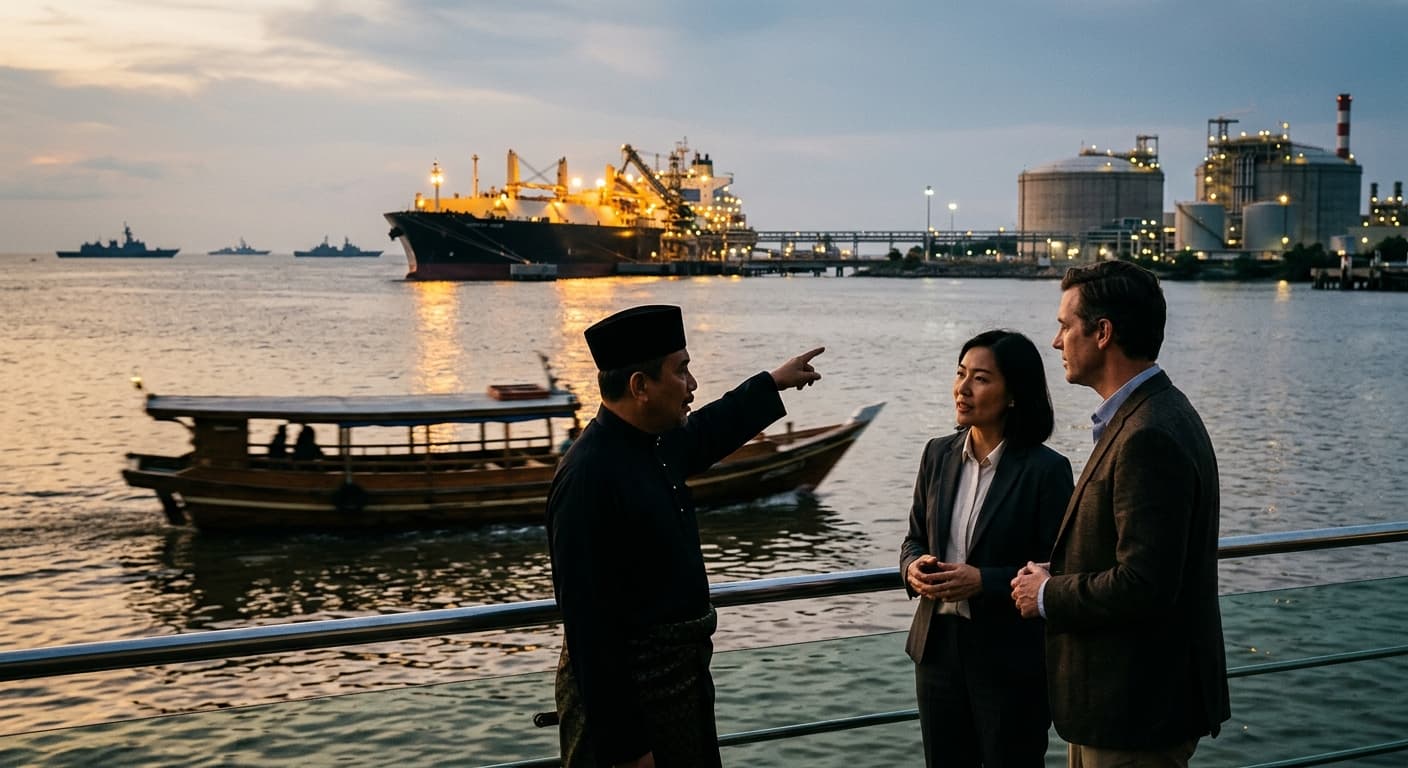
Geopolitically, Brunei sits astride vital sea lanes and holds exclusive economic zone claims that overlap with those of China, Malaysia, Vietnam, and the Philippines in the South China Sea. Its foreign policy has long been defined by careful balancing: maintaining strong defense ties with the United Kingdom and the United States while expanding economic relations with Beijing. This delicate posture reflects the broader dilemma facing ASEAN states caught between economic dependence on China and security concerns regarding Beijing’s assertiveness.
Brunei’s Energy Economy in a Changing Global Landscape
Brunei’s economic model remains classic rentier state. The Brunei Shell Petroleum Company, a joint venture with Shell established in 1929, continues to dominate upstream production. Liquefied natural gas (LNG) exports, primarily to Japan, South Korea, and increasingly China, have been the cornerstone of national prosperity since the first cargo departed in 1972.
According to recent data from the International Energy Agency, Brunei exported approximately 7.2 million tonnes of LNG in 2025, with Japan and South Korea traditionally absorbing the majority. However, Chinese imports of Bruneian LNG have grown steadily, rising from less than 10% of total exports a decade ago to nearly 25% in 2025. This shift mirrors broader regional trends as China seeks to diversify its energy sources away from Australia and Qatar while deepening economic ties with Southeast Asian producers.
The energy transition presents both risks and opportunities. Brunei has committed to achieving net-zero emissions by 2050, a bold target for a country whose wealth derives almost entirely from fossil fuels. The government has invested in downstream industries, including a $2.8 billion methanol plant and various petrochemical projects, while exploring opportunities in renewable energy and carbon capture. Yet analysts remain skeptical about the pace of diversification. The IMF noted in its 2025 Article IV consultation that Brunei’s non-oil and gas GDP growth has averaged less than 2% annually over the past decade, underscoring the difficulty of weaning the economy off hydrocarbons.
South China Sea: Where Economics Meets Security
Brunei’s most sensitive geopolitical issue lies beneath the waters of the South China Sea. The country claims roughly 3,000 square kilometers of maritime territory, including the Louisa Reef (known as Pulau Semarang Barat in Malay), which falls within China’s controversial nine-dash line. Unlike the Philippines and Vietnam, Brunei has pursued a notably quiet approach to its claims, preferring diplomatic channels and avoiding direct confrontation.
This restraint has not gone unnoticed in Beijing. China has cultivated close economic ties with Brunei, including significant infrastructure investments under the Belt and Road Initiative. The Muara Port expansion project, partially funded by Chinese loans, aims to transform Brunei into a regional logistics hub. Chinese state-owned enterprises have also explored joint development arrangements in disputed waters, a model Beijing has repeatedly proposed to other claimant states.
Brunei’s position differs from its ASEAN neighbors in important ways. It lacks the military capacity to challenge Chinese naval presence and has no desire to internationalize its claims through litigation akin to the Philippines’ 2016 arbitral victory. Instead, Bandar Seri Begawan has emphasized the importance of the 2002 Declaration on the Conduct of Parties in the South China Sea and supported ongoing negotiations for a Code of Conduct, while quietly strengthening defense cooperation with external powers.
The United States maintains a modest but symbolically important defense relationship with Brunei. U.S. Navy ships make regular port calls at Muara, and the two countries participate in joint military exercises under the framework of Cooperation Afloat Readiness and Training (CARAT). The presence of British Gurkha troops, stationed in Seria under a long-standing agreement with the Sultan, adds another layer of external security assurance.
Great Power Competition and Brunei’s Strategic Hedging
Brunei exemplifies the hedging strategy employed by many small and medium-sized Southeast Asian states. It seeks to maximize economic benefits from China while maintaining security relationships with the United States, United Kingdom, and other partners to hedge against potential coercion.
During the second Trump administration, which began in January 2025, Washington has placed renewed emphasis on countering Chinese influence in Southeast Asia. The administration’s Indo-Pacific strategy has focused on strengthening bilateral ties with key partners while encouraging ASEAN states to reduce strategic dependencies on Beijing. For Brunei, this has translated into increased high-level diplomatic engagement, including a visit by Secretary of State Marco Rubio in late 2025.
China, for its part, continues to view Brunei as an important test case for its “peripheral diplomacy.” By offering economic incentives and respecting Brunei’s preference for quiet diplomacy, Beijing hopes to demonstrate that smaller states can benefit from closer alignment without sacrificing sovereignty. The approach contrasts with Beijing’s more confrontational posture toward Vietnam and the Philippines.
Japan and South Korea also play important roles in Brunei’s strategic calculus. Both countries are major investors in the energy sector and important markets for Bruneian LNG. Tokyo has provided technical assistance for Brunei’s economic diversification efforts, while Seoul has explored opportunities in halal food production and Islamic finance, aligning with Brunei’s identity as a Malay Islamic Monarchy.
Regional Context: ASEAN, AUKUS, and Emerging Alignments
Brunei’s foreign policy cannot be separated from broader developments within ASEAN. As the current ASEAN chair in 2026, Brunei faces the challenging task of maintaining organizational cohesion amid intensifying great power rivalry. The grouping remains divided between states with closer economic ties to China (Cambodia, Laos) and those more concerned about Chinese assertiveness (Vietnam, Philippines).
The deepening of AUKUS cooperation between Australia, the United Kingdom, and the United States has complicated ASEAN’s strategic environment. While Brunei has not publicly criticized the pact, it shares the concerns of Indonesia and Malaysia regarding potential arms races and nuclear proliferation in the region. At the same time, the country benefits from the stabilizing presence of external powers as a counterweight to Chinese military expansion.
Energy politics further complicates regional dynamics. Southeast Asia’s growing demand for LNG, driven by coal-to-gas switching in power generation, has increased competition for supplies. Brunei’s position as a reliable exporter gives it leverage, but it must navigate price volatility and competition from new producers, particularly the United States and Qatar.
Economic Challenges and the Post-Hydrocarbon Future
Despite its high GDP per capita (approximately $37,000 in 2025), Brunei faces significant structural economic challenges. Youth unemployment hovers around 15%, and many young Bruneians seek opportunities abroad. The government’s generous welfare system, including free healthcare, education, and subsidized fuel, has created what economists term a “resource curse” dynamic, reducing incentives for private sector innovation.
Successive development plans, including the current Wawasan 2035, have emphasized economic diversification, digital transformation, and human capital development. Progress has been modest. The financial services sector, particularly Islamic banking and fintech, shows promise, as does tourism, which the government hopes to expand following the easing of pandemic restrictions.
The global energy transition poses existential questions. As major importers like Japan and South Korea set ambitious decarbonization targets, demand for Bruneian LNG may peak within the next decade. The country has invested in blue hydrogen and carbon capture utilization and storage (CCUS) technologies, but commercial viability remains uncertain. Brunei’s participation in the ASEAN Power Grid initiative and exploration of renewable energy exports represent potential pathways toward a more sustainable economic model.
Conclusion: The Perils and Promise of Strategic Smallness
Brunei’s experience illustrates both the vulnerabilities and advantages of being a small state in a region dominated by great powers. Its substantial energy resources and strategic location provide leverage that many similarly sized countries lack. Yet the very factors that generate wealth also create dangerous dependencies and limit policy options.
As U.S.-China competition intensifies, Brunei will likely continue its policy of strategic hedging: deepening economic cooperation with China while quietly strengthening security ties with Western partners and maintaining ASEAN centrality as its diplomatic North Star. The country’s leadership appears to recognize that overt alignment with any single power would be counterproductive.
The coming decade will test Brunei’s ability to navigate multiple transitions simultaneously: from fossil fuels to a more diversified economy, from traditional diplomacy to more complex multilateral engagement, and from a comfortable rentier model to one based on innovation and private sector growth. Success is far from guaranteed, but the sultanate’s history of pragmatic adaptation suggests it possesses the diplomatic skill to maintain its sovereignty and prosperity amid turbulent waters.
In an era where energy security, maritime politics, and geoeconomic competition increasingly intersect, Brunei’s quiet diplomacy offers important lessons for other small states seeking to preserve autonomy in a fragmenting international order. Its success or failure will not only determine the future of its 450,000 citizens but may also signal broader trends in Southeast Asia’s evolving geopolitical landscape.
Share This Article