Jonathan van den Berg · May 12, 2026
Bitcoin ATMs Face Crackdown as Crypto Challenges Traditional Finance
Local governments are banning Bitcoin ATMs amid rising fraud concerns, putting everyday crypto users at risk while big institutions tighten their grip on digital money. This shift could accelerate the move away from old financial power structures.
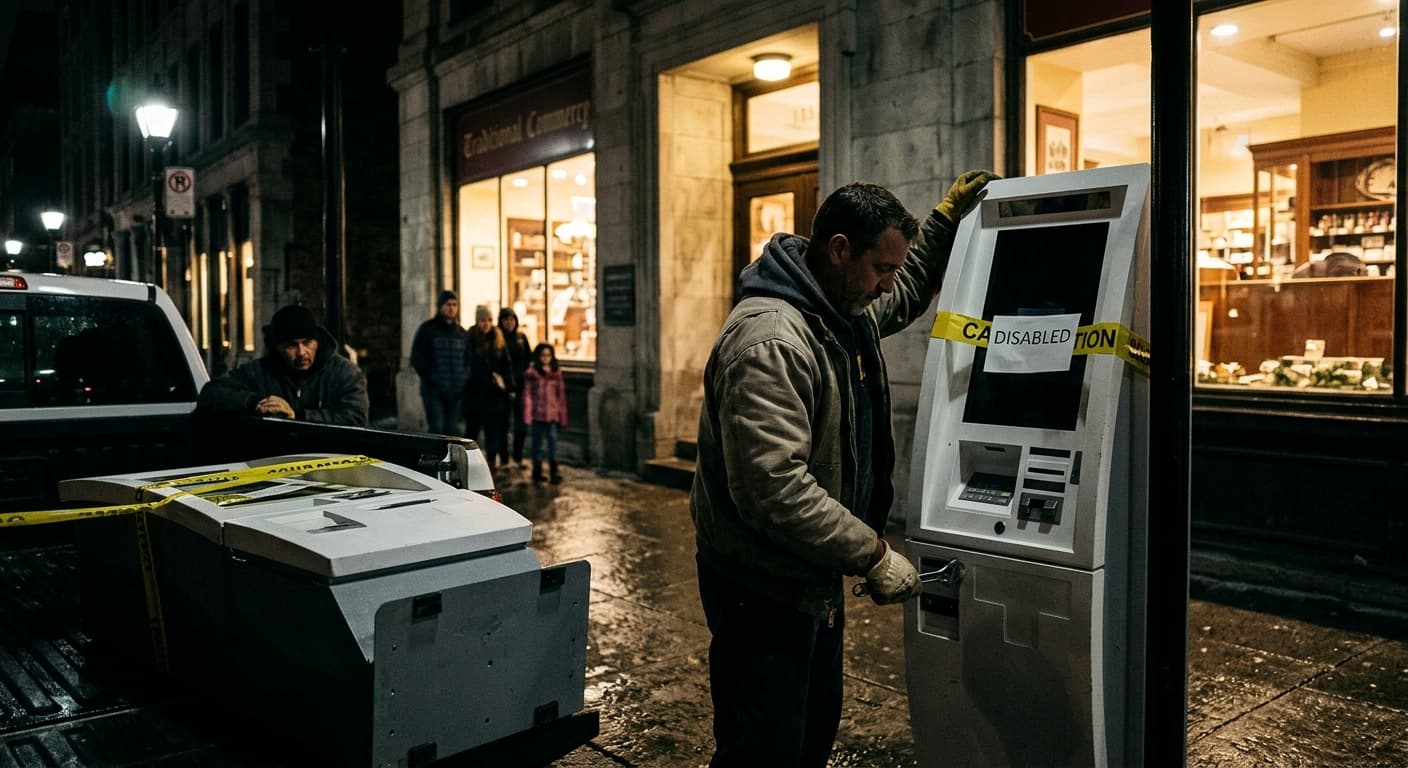
Bitcoin ATMs are under siege.
Cities and states across the United States have begun banning or severely restricting these kiosks that let people buy bitcoin and other cryptocurrencies with cash. The crackdown comes as authorities point to rising fraud, money laundering, and scams that prey on regular people. Yet the story runs deeper than simple crime prevention. These machines sit at the crossroads of a larger fight over who controls money in the digital age.
For many users, Bitcoin ATMs offered the simplest on-ramp into crypto. No bank account needed. Just insert cash and walk away with digital coins sent to your wallet. That ease made them popular in neighborhoods banks often ignore. Now that access is disappearing in places like Spokane Valley, Washington, where officials voted to prohibit new virtual currency kiosks.
The Fraud Problem Driving the Bans
Regulators and police say Bitcoin ATMs have become tools for scammers. Criminals often trick elderly victims into buying bitcoin at these machines and sending it to fraudsters. Once the transaction clears on the blockchain, the money is nearly impossible to recover.
Reports from law enforcement show crypto ATM fraud losses reached hundreds of millions of dollars in recent years. One common tactic involves imposters pretending to be government officials or tech support workers. They convince targets to purchase crypto as a supposed "proof of funds" or to pay fake taxes.
CoinFlip, a major Bitcoin ATM operator, has faced scrutiny in multiple states. Investigators found patterns where machines in certain locations served almost exclusively as outlets for scam proceeds. In Minnesota, authorities highlighted how some ATMs processed suspicious flows that traced back to overseas fraud rings.
These concerns are real. Real people lose their life savings. Families suffer. But the response — outright bans in certain jurisdictions — raises questions about whether officials are targeting symptoms instead of root causes.
How Bitcoin ATMs Actually Work
Most Bitcoin ATMs connect directly to crypto exchanges. When you feed in dollars, the machine buys bitcoin at the current market rate and sends it to the address you provide. Fees often run between 5% and 20%, much higher than online exchanges.
The machines appeal to two very different groups. First, crypto enthusiasts who value privacy and want to avoid linking their identity to transactions. Second, people outside the traditional banking system — immigrants, gig workers, and those with poor credit.
This second group finds the machines useful for sending money across borders quickly. A construction worker in Los Angeles can buy bitcoin and have his family in Mexico withdraw equivalent local currency through similar services. Traditional wire transfers can take days and charge high fees. Crypto can move in minutes.
Yet that speed and relative privacy also attract criminals. The same features that help a grandmother send money to her grandson make it easier for a scammer to cash out ill-gotten gains.
The Geopolitical Angle: Crypto as Sanctions Evasion Tool
Beyond street-level fraud lies a bigger battle. Governments worry that widespread crypto adoption chips away at their control over financial flows. This connects directly to larger questions about the erosion of the petrodollar system that has dominated global trade for decades.
When countries like Russia, Iran, or Venezuela face sanctions, they look for workarounds. Bitcoin and stablecoins have emerged as practical options. While large-scale evasion usually involves more sophisticated methods than public ATMs, the machines still represent a visible symbol of decentralized finance that operates outside traditional banking rails.
The erosion of the petrodollar and cryptocurrency’s strategic crossroads has leaders in Washington and other capitals paying close attention. Each new Bitcoin ATM installation represents another node in a network that doesn't require permission from central authorities.
This explains why some of the loudest calls for restrictions come from federal agencies focused on money laundering and sanctions enforcement. The Financial Action Task Force (FATF), an international body that sets anti-money laundering standards, has pushed countries to implement stricter rules on virtual asset service providers, including ATM operators.
Local Politics Meets Global Finance
The Spokane Valley ban reflects a growing trend of local governments taking action where federal rules lag. Officials cited specific incidents of fraud tied to machines in their area. They argued that the potential harm to residents outweighed the benefits of unrestricted access.
Similar debates play out in cities nationwide. Some places require operators to register with police, maintain security cameras, and limit transaction sizes. Others have imposed outright moratoriums.
These local decisions matter. They shape where ordinary people can access crypto. In neighborhoods with few banking options, the loss of a Bitcoin ATM can push residents toward even less regulated alternatives or back into high-cost check cashing services.
The pattern echoes other fights over access to financial tools. Payday lenders, check cashers, and money transfer services have faced similar regulatory pushes over the years. The difference with crypto is its borderless nature and direct challenge to how governments manage money.
Industry Response and Adaptation
Bitcoin ATM companies aren't taking the crackdowns quietly. Many now require stronger identity verification, including scans of government ID and sometimes even biometric checks. Transaction limits have dropped in regulated areas.
Some operators have shifted focus to more compliant markets or pivoted to business services. Others invest in better monitoring software that flags suspicious activity in real time.
The larger crypto industry finds itself in an awkward position. Many leaders acknowledge the fraud problem but argue that banning machines punishes legitimate users. They point out that traditional banks still move far more dirty money than crypto networks, according to data from firms like Chainalysis.
Yet public perception often lags behind the data. When headlines scream about grandmothers losing retirement funds to crypto scams, nuanced arguments about overall illicit finance volumes don't sway many voters or politicians.
Connection to Broader Economic Power Shifts
This ATM crackdown happens against a backdrop of major changes in how global finance works. Central banks are exploring digital currencies. Governments experiment with programmable money that could give them more direct control over spending.
At the same time, decentralized alternatives continue growing. The tension between these approaches defines much of today's financial landscape.
For regular people, the practical impact is clear. If Bitcoin ATMs become harder to find, newcomers to crypto will likely start with apps on their phones that require bank connections. That means more personal data tied to their transactions. It means less privacy. It also means easier government oversight.
Whether that's good or bad depends on your view of financial surveillance. Supporters say it protects people from scams and stops criminals. Critics worry it concentrates too much power in the hands of banks and regulators who have their own track record of failures and biases.
What the Data Actually Shows
Looking at the numbers helps separate hype from reality. While crypto ATM fraud makes for alarming headlines, most estimates suggest illicit activity represents less than 1% of total crypto transaction volume. The vast majority of bitcoin moves through regulated exchanges that collect customer information.
That said, the absolute dollar amounts involved in ATM-related scams have grown as crypto prices rose. A sophisticated operation can extract millions from victims in weeks.
Law enforcement faces genuine challenges. Blockchain transactions are public but often hard to link to real-world identities without cooperation from exchanges or wallet providers. International scammers operate from jurisdictions with weak cooperation agreements.
These enforcement gaps drive the impulse to simply remove the machines. It's a blunt tool, but one that produces immediate results in specific neighborhoods.
The Future of Cash-to-Crypto Access
As restrictions spread, several trends are emerging. First, more Bitcoin ATMs will require full Know Your Customer (KYC) procedures — basically treating them like mini-banks. This reduces anonymity but also cuts fraud.
Second, smartphone apps and online platforms will likely absorb much of the demand. Services that let you buy crypto with a debit card or bank transfer continue improving their user experience.
Third, peer-to-peer trading may grow in areas where machines disappear. Apps that match local buyers and sellers have gained popularity in countries with strict banking controls. This shift could actually increase privacy for some users while creating new risks of in-person scams.
The cat-and-mouse game between regulators and crypto users continues. Each ban creates incentives for workarounds. Each new regulation adds friction that drives some users toward less transparent options.
Why This Matters for Everyday People
Most readers don't think about sanctions, petrodollars, or global financial architecture when they see a Bitcoin ATM at the corner store. They see a machine that might help them buy some bitcoin, send money to family abroad, or simply experiment with new technology.
Yet these local decisions feed into larger patterns. When governments limit decentralized financial tools, they preserve the power of existing institutions. When they allow them, they accept some loss of control — and the risks that come with it.
The fraud cases are heartbreaking. Victims deserve protection. But policymakers face a harder question: how do you secure the system without closing off innovation and access that benefits millions of people who never commit crimes?
The answer likely lies somewhere between outright bans and completely unregulated machines. Smarter monitoring, better public education about scams, and targeted enforcement against bad actors could address the real problems without throwing out the benefits.
Meanwhile, the larger shift continues. Money is becoming more digital, more programmable, and less tied to physical cash. How societies manage that transition will shape economic opportunities for decades to come.
The Bitcoin ATM sitting outside your local gas station isn't just a convenient gadget. It's a small piece of a much larger puzzle about power, privacy, and who gets to decide what counts as legitimate money in the 21st century.
As restrictions spread, users will adapt. The technology itself is hard to ban completely. The real question isn't whether crypto access will exist. It's who will control the on-ramps — and at what cost to both security and freedom.
Looking Ahead
The coming years will test different approaches. Some regions will double down on restrictions. Others will try regulated integration. The results will provide valuable data about what actually reduces fraud while preserving useful financial innovation.
For now, if you rely on Bitcoin ATMs, check local rules before you travel. Many operators have updated their apps to show which machines remain available in different areas. Consider stronger verification options if privacy matters less to you than reliability.
The fight over Bitcoin ATMs reveals something important about technological change. Society rarely rejects new tools completely. Instead, it negotiates terms. Those negotiations determine who benefits and who bears the risks.
In the case of crypto kiosks, that negotiation is happening right now in city council meetings, state legislatures, and federal agencies. The outcomes will affect not just crypto enthusiasts but anyone who cares about how money works in an increasingly digital world.
The machines themselves may become rarer in many American cities. But the forces driving their creation — desire for financial alternatives, frustration with traditional banking, and belief in decentralized systems — show no signs of disappearing.
Share This Article